Your company wants to send employees for NFPA training. However, when the HR department requests a quotation, one important question arises: which NFPA standard should the team actually learn?
A facility manager responsible for sprinkler maintenance may need different technical knowledge from a Fire Safety Officer overseeing building inspections. Meanwhile, an Emergency Response Team leader may benefit more from practical response training.
Selecting the wrong programme can waste training budgets and leave important competency gaps unresolved.
NFPA training Malaysia helps engineers, safety professionals, facility managers and emergency personnel understand internationally recognised fire protection, electrical safety and life-safety practices.
However, the National Fire Protection Association (NFPA) develops hundreds of codes and standards. These documents address different systems, hazards and professional responsibilities.
Therefore, organisations should not choose training based only on the NFPA name.
Instead, they need to identify the relevant standard, understand the intended learning outcomes and verify the training provider’s credentials.
AFSA Academy offers professional training in fire safety, emergency response and related workplace safety disciplines, with NFPA listed among its professional development areas.
This guide explains the differences between important NFPA standards, how to select suitable training and what Malaysian employers should check before registration.
ㅤ
ㅤ
What Is NFPA Training?
NFPA training introduces participants to relevant codes, standards and technical principles developed by the National Fire Protection Association.
NFPA is an international organisation that develops recognised documents covering fire protection, electrical safety, building safety, emergency response and other risk-related disciplines.
Its standards provide technical guidance that organisations may use when designing, maintaining or managing fire and life-safety arrangements.
However, different NFPA documents address different responsibilities.
For example, one standard may focus on portable fire extinguishers, while another covers fire alarm systems or sprinkler maintenance.
A suitable training programme should help participants understand the purpose of the relevant standard and how its provisions relate to their work.
Depending on the course, participants may learn how to interpret technical terminology, review inspection records, identify system responsibilities and communicate effectively with qualified contractors.
Some programmes also provide practical exercises or prepare candidates for separate professional assessments.
Nevertheless, completing one NFPA-related course does not establish competency across every fire protection discipline.
Organisations should select training based on their actual needs rather than assuming all NFPA courses provide the same knowledge.
ㅤ
ㅤ
Why Malaysian Organisations Use NFPA Standards
Malaysian businesses operate different types of buildings and industrial facilities, each with its own fire safety risks.
Manufacturing plants may need to manage sprinkler systems, machinery hazards and emergency response arrangements.
Meanwhile, commercial buildings often rely on fire alarm systems, escape routes, fire protection equipment and scheduled maintenance.
NFPA standards can provide recognised technical references for understanding these systems.
For example, a building engineer who understands the relevant inspection terminology can review maintenance reports more effectively.
Similarly, a facility manager familiar with system impairment procedures may communicate more clearly with the maintenance contractor when equipment becomes temporarily unavailable.
However, organisations must recognise an important distinction.
NFPA standards do not automatically replace Malaysian legislation or regulatory requirements.
Businesses must continue to follow applicable Malaysian laws, requirements imposed by Jabatan Bomba dan Penyelamat Malaysia (JBPM), approved building plans and other relevant conditions.
In some cases, specific NFPA standards or editions may form part of contractual requirements, technical specifications or approved system designs.
Therefore, management should confirm which documents apply before adopting a standard for a particular project.
For official Malaysian fire safety information, organisations can refer to the Fire and Rescue Department of Malaysia.
ㅤ
ㅤ
NFPA Training vs NFPA Certification: What Is the Difference?
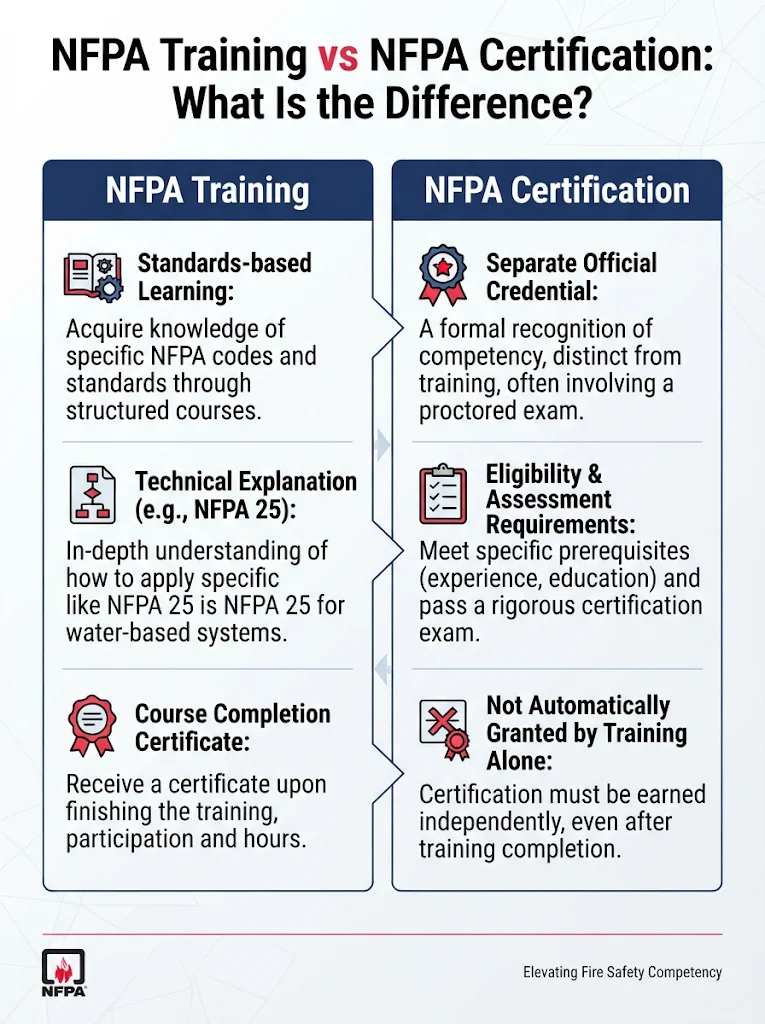
One common misunderstanding involves the difference between attending an NFPA-related training course and obtaining an official NFPA professional certification.
These are not necessarily the same achievement.
NFPA Standards Training
Standards-based training focuses on explaining a selected NFPA document or technical subject.
For example, a course may introduce NFPA 25 inspection and maintenance principles to building maintenance personnel.
Participants may receive a training provider’s certificate after completing the programme.
However, that certificate does not automatically represent an official NFPA professional credential.
Course Completion Certificates
Training providers may issue certificates of attendance or completion according to their own programme arrangements.
Before registration, employers should confirm who issues the certificate, what it represents and whether the course includes an assessment.
The certificate should accurately describe the programme completed.
NFPA Professional Certification
NFPA operates separate professional certification programmes that require candidates to satisfy specific eligibility and assessment conditions.
The requirements depend on the relevant credential.
According to NFPA’s official training information, completing a training course does not automatically grant professional certification.
For employers, this distinction matters when recruiting personnel or planning employee development.
An employee who attends technical awareness training should not be described as NFPA-certified unless they have obtained the relevant professional credential.
ㅤ
ㅤ
Common NFPA Standards Used in Fire Safety Training
The most suitable NFPA standard depends on the organisation’s equipment, workplace risks and employee responsibilities.
Four commonly referenced standards illustrate how different training needs can arise.
| NFPA Standard | Main Focus | Relevant Personnel |
| NFPA 10 | Portable fire extinguishers | Safety personnel, maintenance teams and facility managers |
| NFPA 25 | Inspection, testing and maintenance of water-based fire protection systems | Building engineers, maintenance managers and fire protection personnel |
| NFPA 72 | Fire alarm and signalling systems | Fire alarm technicians, engineers and facility teams |
| NFPA 101 | Building and occupant life safety | Building managers, engineers, architects and safety professionals |
These standards do not form a single general-purpose course.
Employers should select the appropriate topic and course depth according to the work performed by their nominated employees.
ㅤ
ㅤ
NFPA 10: Portable Fire Extinguisher Standards
NFPA 10 addresses the selection, installation, inspection, maintenance and testing of portable fire extinguishers.
This standard is relevant to organisations that manage extinguishers across offices, industrial facilities, warehouses and commercial buildings.
For example, a facility manager may need to understand equipment placement, inspection responsibilities and the importance of maintenance records.
Meanwhile, maintenance personnel may need more technical knowledge about extinguisher condition and servicing arrangements.
However, technical NFPA 10 training should not be confused with practical firefighting training.
A standards-based programme may explain equipment requirements, whereas practical firefighting training focuses on recognising hazards and using equipment safely within defined limits.
These learning objectives complement each other but are not interchangeable.
Employers should therefore identify whether they need technical standards awareness, practical firefighting competency or both.
ㅤ
ㅤ
NFPA 25: Water-Based Fire Protection Systems
NFPA 25 provides requirements for the inspection, testing and maintenance of water-based fire protection systems.
These systems can include sprinklers, standpipes, fire pumps, valves and associated components.
For building owners and facility management teams, understanding inspection and maintenance responsibilities is particularly useful.
Consider a commercial building with a sprinkler system maintained by an external contractor.
The contractor may conduct the technical testing, but the facility manager still needs to understand the inspection programme, review reports and follow up on identified problems.
NFPA 25 training can help appropriate personnel interpret the responsibilities associated with these activities.
However, employees should not undertake specialist testing simply because they have attended an awareness programme.
The organisation must assign technical work to competent and appropriately authorised personnel.
The official NFPA 25 standard information provides further details about the document and its current edition.
ㅤ
ㅤ
NFPA 72: Fire Alarm and Signalling Systems
A fire alarm system plays an important role in warning occupants and supporting emergency response arrangements.
However, the effectiveness of the system depends on its design, installation, operation and maintenance.
NFPA 72, the National Fire Alarm and Signaling Code, addresses fire alarm and related signalling systems.
Training may introduce participants to initiating devices, notification appliances, alarm communication, inspection requirements and system documentation.
For example, a facility manager may receive a maintenance report identifying a system impairment.
Understanding the relevant terminology can help the manager communicate with the contractor and coordinate appropriate follow-up actions.
Meanwhile, an engineer or technician may require more detailed training on system configuration and testing.
The correct course level should reflect the participant’s actual responsibilities.
Organisations should also remember that reliable alarm equipment must operate alongside effective evacuation and emergency procedures.
An alarm alone cannot ensure an organised workplace response if employees do not understand what to do.
ㅤ
ㅤ
NFPA 101: Life Safety in Buildings
NFPA 101 is known as the Life Safety Code.
It addresses measures intended to protect building occupants from fire and related hazards.
Relevant subjects include means of egress, occupancy characteristics, building protection features and occupant safety.
These concepts may be particularly useful to building managers, architects, engineers and fire safety professionals.
For example, a property management team responsible for a commercial building must understand how escape arrangements affect occupants during an emergency.
The team may need to consider exit access, emergency lighting, evacuation procedures and the needs of different building users.
NFPA 101 training can support broader technical understanding of these issues.
However, Malaysian building owners must continue to follow applicable local regulations, approved designs and authority requirements.
A foreign standard should not be used to override the legal or approved building requirements that apply locally.
ㅤ
ㅤ
How to Choose the Right NFPA Course in Malaysia
Selecting an appropriate course begins with understanding the organisation’s actual needs.
Rather than asking which NFPA course is most popular, employers should ask what knowledge their employees require.
Identify the Workplace Risk or System
The first step is to identify the equipment, process or safety responsibility involved.
For example, a facility team responsible for sprinkler maintenance may benefit from learning about NFPA 25.
Meanwhile, personnel dealing with fire alarm systems may require training related to NFPA 72.
If the objective involves emergency response, a practical training programme may be more appropriate than a course focused entirely on technical codes.
Understand the Participant’s Job Role
Different employees require different levels of technical knowledge.
A maintenance technician may need detailed equipment information.
A building manager may focus more on contractor coordination, documentation and inspection responsibilities.
Meanwhile, a Fire Safety Officer may need to understand how fire protection systems support routine inspections and workplace safety arrangements.
The course should match what the employee is expected to do after training.
Define the Learning Outcome
Before selecting a programme, management should establish what participants should gain.
For example, the company may want employees to interpret inspection records, recognise technical issues, support maintenance planning or prepare for a professional assessment.
Clearly defined outcomes help employers compare training options and evaluate whether the programme is relevant.
They also reduce the risk of sending employees to a course that does not address their operational responsibilities.
ㅤ
ㅤ
Building an NFPA Training Matrix for Your Employees
Large organisations may need different training programmes for different departments.
A training matrix helps management organise these requirements.
For example:
| Employee Group | Potential Training Focus |
| Facility Managers | NFPA 25, fire system maintenance awareness and inspection records |
| Building Engineers | NFPA 72, system functionality and relevant technical requirements |
| Fire Safety Managers and Officers | Fire protection systems, inspections and building life safety |
| Emergency Response Teams | Relevant safety principles and practical emergency response |
| Maintenance Personnel | Equipment-specific inspection and maintenance responsibilities |
The matrix should reflect the company’s actual systems and responsibilities.
For example, an organisation without a particular type of fire protection system may not need detailed training about that equipment.
Meanwhile, a facility operating several complex systems may need multiple training pathways.
Management should also record completed programmes, assessment results, certificate details and any relevant refresher requirements.
This provides a clearer overview of workforce competency.
However, training records should not be treated as evidence that every employee is authorised to perform specialist work.
ㅤ
ㅤ
Practical NFPA Training vs Classroom-Based Training
NFPA standards often contain technical requirements, definitions and specialist terminology.
Therefore, classroom-based learning remains useful for understanding a document’s structure and purpose.
However, participants also need to connect the information with workplace situations.
For example, a course covering NFPA 10 may include examples of extinguisher placement and inspection records.
Meanwhile, training related to NFPA 25 may involve reviewing maintenance reports and identifying common system components.
Appropriate learning activities may include case studies, group discussions, document reviews and technical demonstrations.
The exact format depends on the course objectives.
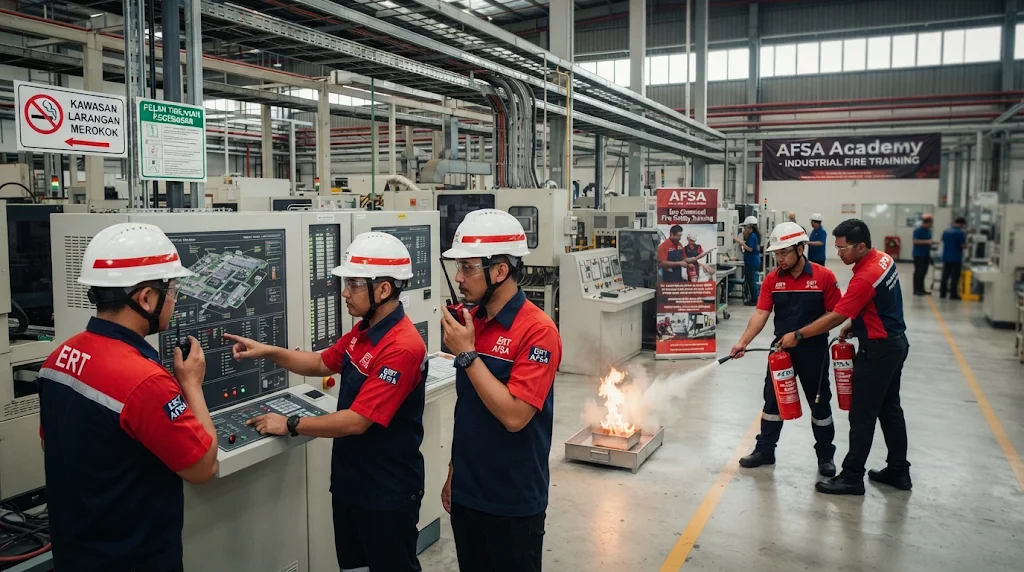
For practical emergency response skills, supervised exercises may be necessary.
However, a classroom-only standards programme should not claim to provide hands-on operational competency without the relevant practical training and assessment.
Organisations should review the course syllabus before registration to ensure that the format matches their intended outcomes.
ㅤ
ㅤ
How to Verify an NFPA Training Provider
Not every course that discusses an NFPA standard is an official NFPA-developed training programme.
Independent training providers may offer courses that explain NFPA-related technical subjects.
However, employers should distinguish these programmes from training officially developed or authorised by NFPA.
NFPA operates an Authorized Education Network (AEN), through which approved training providers deliver eligible NFPA-developed courses using approved instructors.
The NFPA Authorized Education Network provides information about this arrangement.
Before enrolling employees, organisations should verify the programme’s actual status.
Important questions include:
- Is the course developed by NFPA or independently by the training provider?
- Who delivers the training?
- What standard and edition does the course cover?
- Does the provider have the relevant authorisation, if official NFPA training is claimed?
- Who issues the completion certificate?
- Is professional certification a separate process?
- Does the course include practical activities or assessments?
These questions help employers compare training proposals more accurately.
For example, a company looking for general technical awareness may consider an independently developed standards-based programme.
However, if the organisation specifically requires official NFPA training or certification, it must confirm that the proposed programme meets those requirements.
Clear information about programme status protects both employers and participants from misunderstandings.
ㅤ
ㅤ
Why the NFPA Standard Edition Matters
NFPA regularly reviews and updates its standards.
Therefore, employers should know which edition a training programme covers.
For example, a building’s approved fire protection design may reference a particular standard edition.
Meanwhile, a new project specification may require a different version.
These differences can influence technical requirements and the relevance of course materials.
Before registration, organisations should confirm the edition used during training.
They should also review whether the programme explains important changes between editions.
However, the newest publication does not automatically replace every requirement applying to an existing Malaysian facility.
Approved building conditions, contracts and regulatory instructions may continue to reference specific documents.
Therefore, employers should verify the applicable edition rather than assume that the latest publication governs every installation.
ㅤ
ㅤ
NFPA Training for Different Industries
NFPA-related technical learning can benefit different sectors, but the most relevant topics will vary.
Manufacturing and Industrial Facilities
Manufacturing organisations may need technical knowledge concerning extinguishers, sprinklers, alarm systems and emergency arrangements.
The appropriate course depends on the facility’s equipment and operational hazards.
Warehousing and Logistics
Warehouses may place particular emphasis on fire protection systems, equipment inspection records and life-safety arrangements.
Building layout, storage conditions and maintenance responsibilities can influence training needs.
Oil, Gas and Petrochemical Operations
Higher-risk facilities may require specialist training involving industrial fire protection, hazardous materials and emergency preparedness.
Management should select training according to the facility’s risks and the personnel’s responsibilities.
Data Centres
Data-centre personnel may need to understand fire detection, suppression arrangements, electrical safety and continuity-related considerations.
However, technical training should reflect the specific systems installed at the facility.
Commercial Buildings and Hospitality
Building management teams may benefit from programmes related to alarms, sprinklers, emergency exits and occupant safety.
Such organisations often need to coordinate employees, maintenance contractors and emergency procedures.
The goal is to select relevant training rather than enrol every department in the same general programme.
ㅤ
ㅤ
How NFPA Knowledge Supports Fire Safety Managers and Officers
Fire Safety Managers (FSMs) and Fire Safety Officers (FSOs) may encounter different fire protection systems as part of their workplace responsibilities.
For example, they may need to review inspection findings, identify equipment concerns or coordinate with maintenance personnel.
Understanding relevant NFPA terminology can support clearer communication and documentation.
However, NFPA technical training does not automatically replace prescribed FSM or FSO competency training.
The programmes serve different purposes.
FSM and FSO training focuses on the relevant professional responsibilities and applicable Malaysian competency requirements.
Meanwhile, NFPA-related training may provide additional knowledge about particular technical systems or standards.
Organisations can review AFSA’s Fire Safety Manager and Fire Safety Officer training programme when planning professional development for eligible personnel.
The combination of appropriate competency training and relevant technical knowledge can support a more structured workplace fire safety programme.
ㅤ
ㅤ
NFPA Knowledge and Emergency Response Team Training
Emergency Response Teams (ERTs) need practical skills to manage incidents within their designated responsibilities.
Relevant technical standards may help personnel understand emergency communication, equipment limitations and safe operating principles.
However, reading an NFPA document does not replace realistic response exercises.
ERT members may need supervised training in evacuation, communication, incident coordination and initial emergency response.
For example, team members should understand who activates the alarm, who manages assembly areas and who communicates with external responders.
Practical training allows the organisation to evaluate these arrangements.
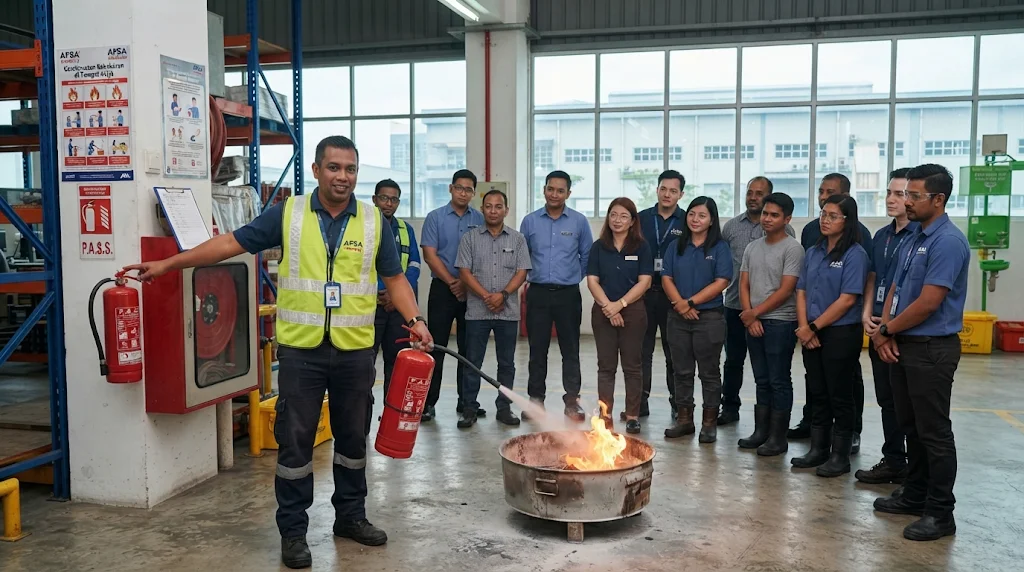
AFSA provides Emergency Response Team training covering operational preparedness and team coordination.
For employers, technical awareness and practical emergency training should be treated as complementary learning activities.
ㅤ
ㅤ
Can NFPA Training Be HRD Corp Claimable?
Eligible Malaysian employers may be able to seek HRD Corp support for qualifying training programmes.
However, the approval process depends on the specific course, employer eligibility and current programme requirements.
A course discussing NFPA standards is not automatically HRD Corp claimable.
Before registration, HR departments should verify the provider’s registration status, programme information and relevant application conditions.
The employer may need a formal quotation, course schedule and other supporting documents.
Any required approval should be obtained according to the applicable HRD Corp procedures.
For current information, organisations can refer to the HRD Corp official website.
Employers should also confirm whether the quoted fees include learning materials, assessments or separate certification charges where applicable.
ㅤ
ㅤ
Why Consider AFSA Academy for Fire Safety Training?
AFSA Academy provides professional training in fire safety, emergency response, firefighting and hazardous materials.
The academy also lists NFPA-related professional development among its training areas.
For employers planning technical or practical training, the first step should be to identify the relevant workplace responsibilities.
For example, an organisation may need technical awareness of fire protection systems alongside practical emergency preparedness.
AFSA’s wider fire safety training programmes include Fire Safety Manager and Fire Safety Officer development, Emergency Response Team training and other workplace safety programmes.
Employers can discuss their industry, employee roles and training objectives with AFSA before selecting a suitable programme.
For NFPA-related training enquiries, confirm the precise standard, course syllabus, instructor arrangements and certificate issuer directly with AFSA.
This is particularly important when the organisation requires a specific authorised NFPA course or professional certification pathway.
Contact AFSA Academy to discuss your company’s training requirements.
ㅤ
ㅤ
Conclusion
NFPA covers a wide range of fire protection, electrical safety and life-safety subjects.
Therefore, choosing an appropriate programme requires more than recognising the NFPA name.
Employers should first identify the relevant workplace systems, hazards and employee responsibilities.
Next, they should determine which standard best supports their training objectives.
The organisation should also verify the provider’s programme status, certificate arrangements and the standard edition used.
Where practical skills are necessary, management should ensure that appropriate hands-on training is included.
NFPA training Malaysia can support stronger technical awareness, clearer communication and more informed workplace fire safety management when organisations select relevant programmes.
For companies seeking professional fire safety development, AFSA Academy offers related training programmes that can support broader employee competency planning.
Explore AFSA’s training programmes or contact AFSA Academy to enquire about suitable NFPA-related training arrangements.
ㅤ
ㅤ
FAQs About NFPA Training Malaysia
What is NFPA training Malaysia?
NFPA training Malaysia refers to programmes that help participants understand selected National Fire Protection Association codes, standards and related fire safety practices relevant to their work.
What does NFPA stand for?
NFPA stands for the National Fire Protection Association, an organisation that develops codes, standards, training resources and professional certification programmes.
Which NFPA standard covers portable fire extinguishers?
NFPA 10 covers the selection, installation, inspection, maintenance and testing of portable fire extinguishers.
What is the difference between NFPA 25 and NFPA 72?
NFPA 25 addresses the inspection, testing and maintenance of water-based fire protection systems. NFPA 72 focuses on fire alarm and signalling systems.
Is NFPA training the same as NFPA certification?
No. Training provides learning or course completion, while professional certification normally involves separate eligibility and assessment requirements.
How can employers verify an authorised NFPA training provider?
Employers should review NFPA’s official authorised training provider information and confirm the status of the programme, instructor and certificate issuer.
Does NFPA training replace Malaysian fire safety regulations?
No. Organisations must still comply with applicable Malaysian legislation, JBPM requirements, approved building plans and other relevant conditions.
Can Fire Safety Managers and Fire Safety Officers attend NFPA training?
Yes, relevant NFPA-related programmes may support their technical knowledge. However, these courses do not automatically replace prescribed FSM or FSO competency requirements.
Is NFPA training suitable for corporate employees?
It may be relevant to engineers, facility managers, safety personnel, maintenance teams and other employees whose responsibilities involve fire protection or life safety.
Is NFPA training HRD Corp claimable?
Eligible programmes may qualify, subject to provider registration, employer eligibility and applicable approval requirements. Employers should verify the specific course before registration.
Does AFSA Academy offer NFPA training?
AFSA lists NFPA among its training areas. Employers should contact AFSA to confirm the specific standards covered, available programme arrangements, course status and certificate details.
How can companies enquire about NFPA training with AFSA?
Organisations can contact AFSA Academy and provide details of their industry, employee roles, relevant fire protection systems and intended training outcomes.