An employee suddenly collapses during a normal working day. Colleagues gather around, but nobody knows where to find the Automated External Defibrillator (AED) or who should contact emergency services.
For many organisations, this is the moment when emergency preparedness faces its most important test.
Workplace first aid training Malaysia helps employees recognise medical emergencies, provide appropriate initial assistance and work together while waiting for professional medical responders.
A well-prepared workplace needs more than a first aid kit. Employees should understand their responsibilities, know how to activate emergency procedures and have opportunities to practise essential response skills.
For employers, this means selecting suitable personnel and providing training that reflects actual workplace risks.
AFSA Academy’s CPR, First Aid and AED training programme supports organisations seeking to develop practical emergency-response competency among their employees.
This guide explains what workplace first aid training covers, how CPR and AED training fit into emergency preparedness, and what employers should consider when developing a reliable first aid arrangement.
ㅤ
ㅤ
Why Workplace First Aid Training Matters
Many businesses prepare for fires, evacuation drills and equipment failures. However, medical emergencies can occur without any obvious warning.
A warehouse employee may suffer a fall. An office worker may experience sudden chest pain, while a maintenance technician could sustain an injury during routine work.
In each situation, the organisation needs a clear response rather than confusion.
Trained first aiders learn to recognise emergencies, protect themselves from hazards, request assistance and provide initial care within their level of competency.
Although first aid cannot replace professional treatment, timely and appropriate action can help support an affected person until medical help arrives.
The Department of Occupational Safety and Health (DOSH) Guidelines on First Aid in the Workplace provide guidance on planning workplace first aid personnel, facilities and equipment.
For employers, first aid training should therefore form part of a wider workplace safety system.
ㅤ
ㅤ
What Does Workplace First Aid Training Cover?
A suitable workplace first aid course should combine essential knowledge with practical learning.
Participants need to understand how different emergencies affect the actions they can safely take.
Depending on the programme, training may address scene safety, emergency communication, initial assessment, basic life support, common injuries and the use of relevant first aid equipment.
AFSA Academy’s programme includes practical learning related to CPR, AED use, choking emergencies, bleeding, injuries and the recognition of medical emergencies.
Recognising Medical Emergencies
Employees should learn to identify situations that require immediate attention.
These may involve sudden collapse, unusual breathing, severe bleeding, choking, suspected stroke or other serious medical symptoms.
Recognising the urgency of a situation helps employees activate the correct workplace response.
However, first aiders should avoid attempting to diagnose conditions beyond their training.
Personal Safety and Initial Assessment
Before helping an affected person, employees should recognise hazards in the surrounding area.
For example, a casualty near operating machinery or a chemical spill may present additional risks to anyone approaching.
Training helps participants understand when it is appropriate to assist and when specialist responders must first control the environment.
Communication and Emergency Assistance
A workplace emergency can become more difficult when several people give conflicting instructions.
First aid training should encourage clear communication, including calling for professional assistance, informing the incident coordinator and giving responders accurate information.
Employees also need to understand who is responsible for retrieving equipment and directing medical teams to the incident location.
Practical First Aid Skills
Relevant practical activities may include managing common injuries, recognising potentially serious conditions and supporting safe emergency handover.
The exact techniques should follow the current course syllabus and applicable professional guidelines.
Participants must practise under suitable instruction rather than rely on written information alone.
ㅤ
ㅤ
First Aid vs CPR vs AED Training: Understanding the Difference
Employers often discuss first aid, CPR and AED training together. Although closely related, each addresses a different aspect of emergency response.
| Training Component | Main Purpose | Typical Learning Focus |
| First Aid | Provide appropriate initial assistance | Injuries, illness recognition and emergency communication |
| CPR | Support circulation during cardiac arrest | Recognising an unresponsive person who is not breathing normally and performing appropriate CPR |
| AED | Support response to certain cardiac emergencies | Locating the device, following prompts and coordinating with responders |
First Aid Training
First aid training covers a range of injuries and medical emergencies that employees may encounter.
It also helps workers understand when professional medical care is necessary.
For example, someone trained in first aid may recognise that a seemingly minor workplace injury requires further assessment because of the circumstances involved.
CPR Training
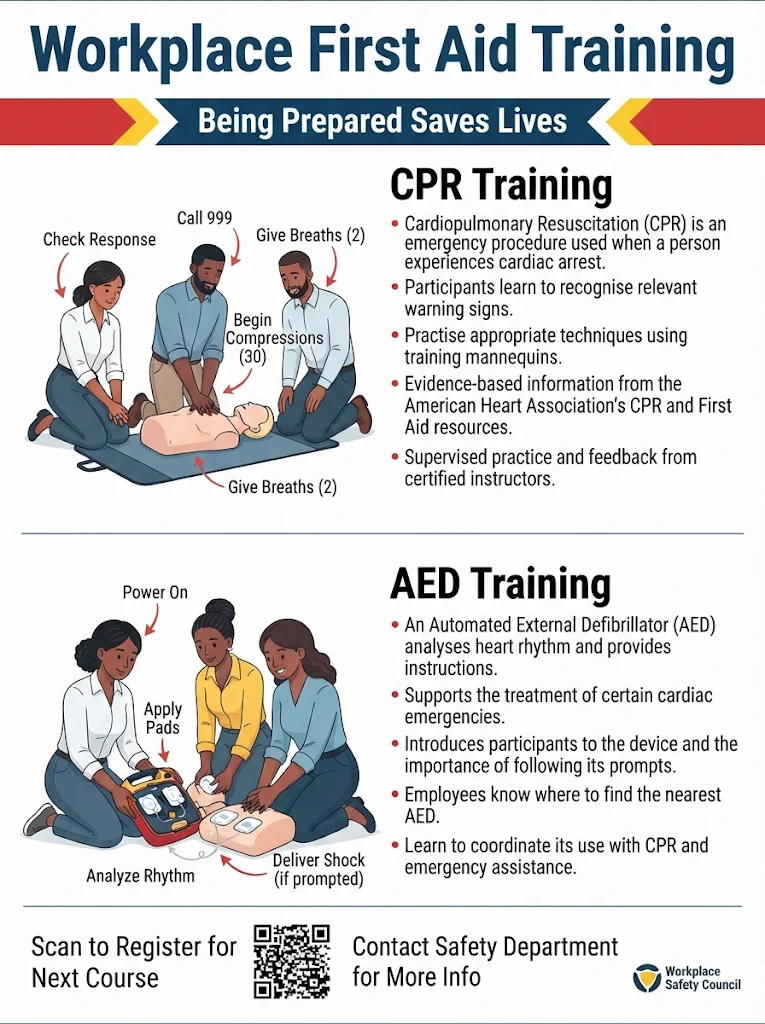
Cardiopulmonary Resuscitation (CPR) is an emergency procedure used when a person experiences cardiac arrest.
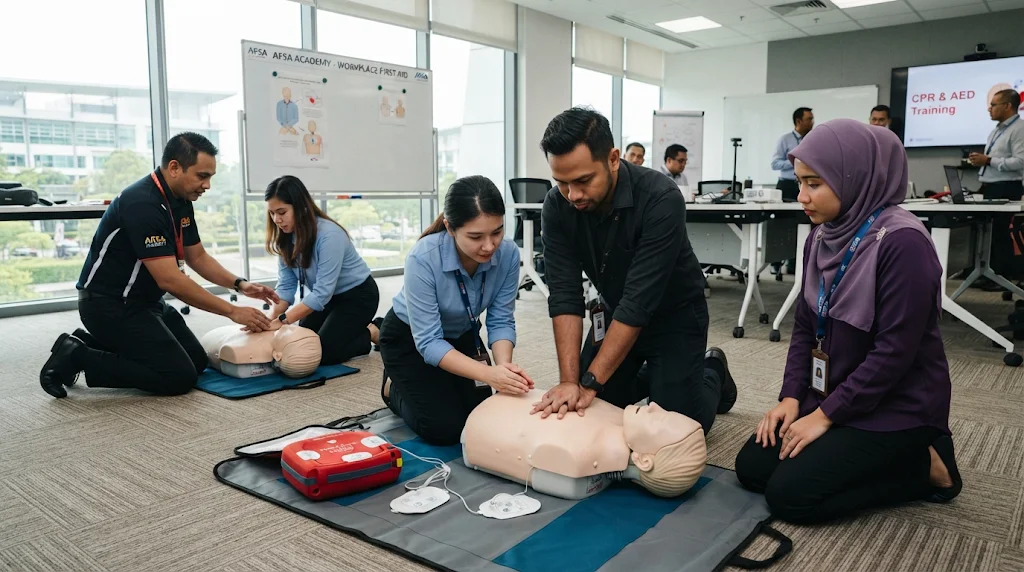
Participants learn to recognise relevant warning signs and practise appropriate techniques using training mannequins.
The American Heart Association’s CPR and First Aid resources provide evidence-based information about resuscitation and emergency response.
Practical instruction remains important because participants benefit from supervised practice and feedback.
AED Training
An Automated External Defibrillator analyses heart rhythm and provides instructions to support the treatment of certain cardiac emergencies.
AED training introduces participants to the device and the importance of following its prompts.
Employees should know where to find the nearest AED and how to coordinate its use with CPR and emergency assistance.
Simply installing an AED does not mean the workplace is ready to use it.
ㅤ
ㅤ
Why Hands-On First Aid Training Is Essential
Reading an emergency procedure is different from applying it under pressure.
During a classroom discussion, participants may understand the correct sequence of communication and response. However, confusion can still arise when several employees must act together.
Practical exercises help bridge this gap.
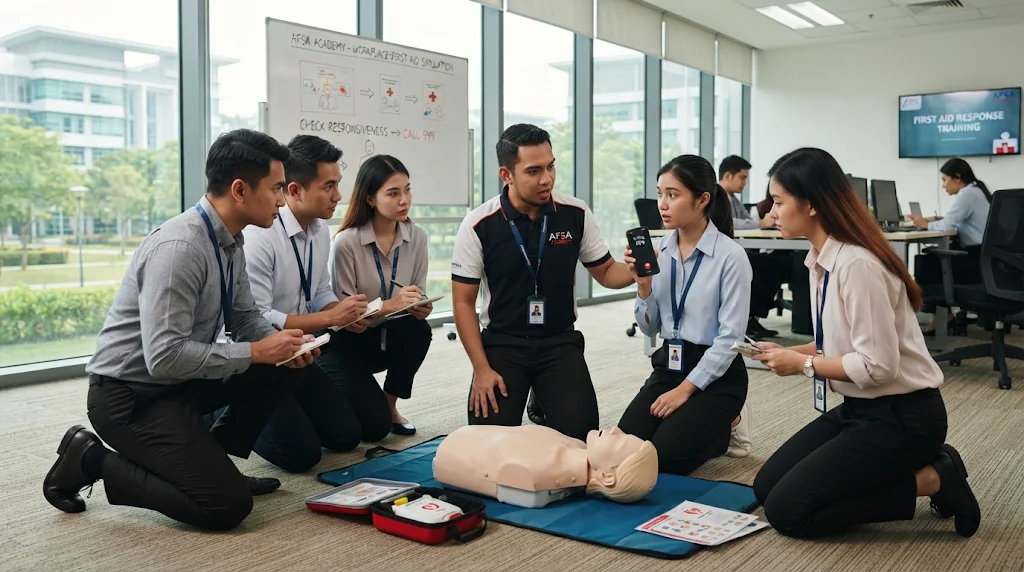
Consider a hypothetical warehouse training scenario. An employee collapses near a loading area while another worker calls for assistance.
Participants must identify the relevant hazards, communicate with the emergency coordinator and locate the required response equipment.
An instructor can observe their decisions and provide feedback.
Such exercises may reveal problems that management previously overlooked.
For instance, the AED may be difficult to locate, emergency numbers may be outdated or employees may not know who has responsibility for opening access gates.
These findings give the organisation an opportunity to improve its procedures before a real incident occurs.
AFSA’s CPR, First Aid and AED programme includes practical training activities that support the development of these skills.
ㅤ
ㅤ
Workplace First Aid Requirements in Malaysia
Employers should approach first aid arrangements as an operational responsibility rather than a certificate-collection exercise.
Malaysia’s Occupational Safety and Health Act 1994 establishes general duties concerning employee safety, health and welfare.
DOSH also provides specific guidance on workplace first aid arrangements.
Its guidelines address considerations such as workplace hazards, number of employees, shift patterns, first aid personnel, equipment and access to medical assistance.
The appropriate arrangements can differ between workplaces.
For example, a low-risk office may have different first aid needs from a chemical processing plant or a construction site.
Employers should consider their current legal obligations alongside the relevant DOSH guidance.
Where specialist workplace risks exist, management may need additional arrangements beyond general first aid training.
The important question is not simply how many employees have attended a course. It is whether appropriately trained personnel and suitable equipment are available when an emergency occurs.
ㅤ
ㅤ
How Many Workplace First Aiders Does a Company Need?
There is no useful one-size-fits-all staffing approach for every organisation.
The number and distribution of first aiders should reflect workplace hazards, employee numbers, operating hours and physical layout, while meeting applicable requirements.
A company operating one office floor has different needs from a manufacturing facility running three shifts.
Consider a factory with 120 employees.
If all trained first aiders work during the morning shift, the company may have inadequate coverage during evening or overnight operations.
Management should therefore review how first aiders are distributed across shifts and work areas.
Other considerations include employee leave, isolated work zones, contractor activities and the distance to professional medical services.
The organisation should also make first aider contact information accessible to employees.
Training additional personnel may be necessary when workforce arrangements change.
ㅤ
ㅤ
Who Should Attend Workplace First Aid Training?
First aid training can benefit employees from different professional backgrounds.
However, employers should prioritise personnel who can provide meaningful emergency-response coverage.
Potential participants include Emergency Response Team members, Safety and Health Officers, security personnel, supervisors, facility managers, maintenance teams and selected operational employees.
The choice should reflect actual workplace needs.
For example, a hotel may need trained staff across reception, security and facilities management. A factory may require suitable personnel across production shifts and maintenance departments.
Schools, logistics centres, construction sites and commercial buildings may also have distinct requirements.
Management should consider employees’ responsibilities, availability and willingness to maintain their competency.
Where several employees perform different emergency roles, the organisation should coordinate their responsibilities carefully.
ㅤ
ㅤ
How First Aid Training Supports the Emergency Response Team
Many workplaces establish an Emergency Response Team (ERT) to coordinate incidents such as fires, evacuations and medical emergencies.
First aiders can form an important part of this structure.
During an incident, the emergency coordinator may manage communication while security personnel guide responders to the correct location.
Meanwhile, appropriately trained first aiders provide initial assistance within their competency.
However, one employee should not automatically be expected to manage several critical responsibilities simultaneously.
A fire warden coordinating an evacuation, for example, may not be available to provide medical assistance.
Clear role allocation can prevent confusion.
Organisations can strengthen this arrangement through AFSA’s Emergency Response Team training, which covers coordinated workplace response responsibilities.
First aid training and ERT development should complement one another rather than operate as unrelated programmes.
ㅤ
ㅤ
Workplace AED Readiness: More Than Installing a Device
An AED can be an important part of workplace emergency preparedness.
Nevertheless, equipment alone cannot ensure an effective response.
Employees need to recognise its purpose, understand where it is located and know how to retrieve it quickly.
The organisation should also consider accessibility during weekends, night shifts and periods when certain departments are closed.
For instance, an AED installed inside a locked administration office may be difficult to reach when an emergency occurs elsewhere in the building.
Management should establish suitable equipment checks and follow the manufacturer’s maintenance instructions.
Signs, emergency communication procedures and refresher training also deserve attention.
The aim is to make AED access part of a practical emergency-response arrangement rather than an isolated equipment purchase.
ㅤ
ㅤ
First Aid Training for Different Workplace Environments
A relevant training programme should account for the types of emergencies that employees may encounter.
Offices and Commercial Buildings
Office employees may need to respond to sudden illness, falls, medical emergencies and incidents involving visitors.
Multi-floor buildings also need clear communication between departments and security teams.
AED location awareness and effective emergency handover may be particularly relevant.
Manufacturing Plants and Warehouses
Factories and warehouses introduce different operational risks.
Employees may work near machinery, loading areas, moving vehicles, hot surfaces or hazardous substances.
Training scenarios should reflect these conditions without encouraging unqualified personnel to enter dangerous areas.
Shift coverage and access to emergency equipment also require careful consideration.
Hotels, Schools and Public Facilities
Public-facing organisations may need to assist employees, visitors, guests or students.
Their emergency arrangements should account for communication, crowd management and the availability of suitably trained personnel.
Chemical and High-Risk Workplaces
Chemical exposure incidents may require specialist protective measures and controlled emergency procedures.
General first aiders must not enter hazardous environments without appropriate protection, training and authorisation.
Such organisations may benefit from combining first aid competency with AFSA’s HAZMAT handling and identification training.
The organisation should select programmes according to its actual hazard profile.
ㅤ
ㅤ
How to Choose a Workplace First Aid Training Provider
Employers should evaluate more than the advertised course price.
A suitable training provider should explain its learning objectives, practical training arrangements, assessment requirements and the intended participant group.
Trainer competency and the suitability of training equipment are also important considerations.
For example, an employer arranging CPR and AED training should confirm that participants have appropriate opportunities for supervised practical exercises.
Companies may also need information about course duration, certificates, refresher requirements and corporate training arrangements.
The provider should be able to explain how the programme addresses relevant workplace emergency situations.
Before confirming enrolment, employers should ask whether the training meets their intended competency requirements and whether any specific recognition is necessary.
AFSA provides a dedicated workplace CPR, First Aid and AED training programme for organisations seeking practical emergency-response training.
ㅤ
ㅤ
Can Workplace First Aid Training Be HRD Corp Claimable?
Employers registered with HRD Corp may be eligible for financial assistance when attending qualifying training programmes.
However, claimability depends on the specific programme, provider arrangements, employer eligibility and applicable approval conditions.
A course should not be assumed to qualify automatically merely because another programme from the same provider is claimable.
HR departments should verify the relevant documentation, application process and approval requirements before training begins.
Official information is available through HRD Corp.
Employers can also request the necessary programme information from AFSA when discussing their training arrangements.
ㅤ
ㅤ
How Often Should Employees Refresh Their First Aid Skills?
First aid readiness requires continued attention after initial training.
Employees may become less confident when they do not practise their skills for an extended period.
Furthermore, workplace conditions can change.
An organisation may introduce new machinery, expand its operations, appoint additional staff or install new emergency equipment.
These changes may affect the suitability of existing first aid arrangements.
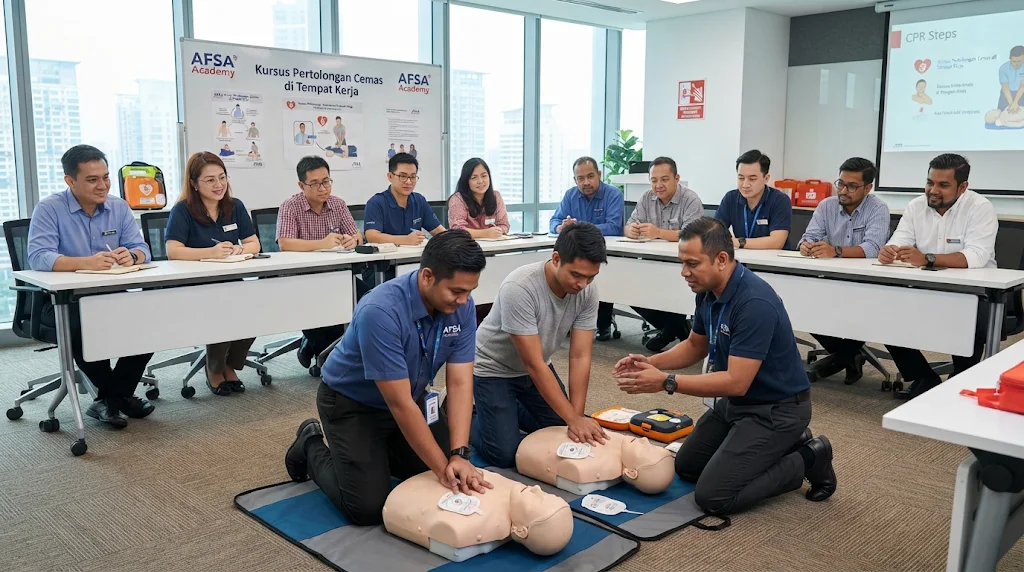
Management should follow relevant certificate conditions, applicable requirements and the training provider’s recommendations when planning refresher training.
Short internal awareness activities can also reinforce equipment locations, emergency contact procedures and role familiarity.
However, these exercises should not replace formal practical training where that training is required.
ㅤ
ㅤ
Measuring Workplace First Aid Readiness
A company should assess whether its first aid arrangements work in practice.
The number of certificates issued is only one part of this assessment.
Management should also review whether trained personnel are available across departments and shifts.
Other useful indicators include equipment inspection records, AED accessibility, updated emergency contact information and lessons identified during workplace exercises.
For example, an organisation may discover that its emergency equipment is in good condition but employees cannot locate it quickly.
Correcting this weakness may be more useful than simply increasing training attendance.
A structured review helps the company identify practical improvements and maintain a more reliable emergency-response programme.
ㅤ
ㅤ
Why Choose AFSA Academy for First Aid, CPR and AED Training?
AFSA Academy provides professional training related to workplace safety, first aid and emergency response.
Its CPR, First Aid and AED training programme covers important learning areas such as basic life support, CPR, AED use, choking response, common injuries and emergency assessment.
The programme includes practical exercises intended to develop participants’ understanding of appropriate emergency actions.
For employers, AFSA also offers related training in emergency response and hazardous-materials awareness.
This allows organisations to consider first aid as part of a broader workplace safety training plan.
Companies can discuss their workforce size, industry, operational risks and intended training outcomes before selecting a suitable programme.
Explore the AFSA training photo and video gallery for examples of its wider training activities.
To enquire about an upcoming course or corporate arrangement, contact AFSA Academy.
ㅤ
ㅤ
Conclusion
A medical emergency can expose weaknesses in workplace preparedness within moments.
Employees need clear responsibilities, suitable equipment and practical skills to respond appropriately.
Workplace first aid training Malaysia helps organisations develop personnel who can recognise emergencies, support CPR and AED response, and provide initial assistance within their competency.
However, effective preparedness extends beyond attending a course.
Employers should review workplace risks, identify suitable first aiders, maintain equipment and ensure that employees can communicate effectively during an incident.
Regular exercises and appropriate refresher training can strengthen these arrangements.
AFSA Academy supports organisations seeking practical first aid, CPR and AED training for their workforce.
Explore AFSA’s CPR, First Aid and AED training programme or submit a training enquiry to discuss your organisation’s requirements.
ㅤ
ㅤ
FAQs About Workplace First Aid Training Malaysia
What is workplace first aid training?
Workplace first aid training prepares employees to recognise medical emergencies, request assistance and provide appropriate initial care within their training and competency.
What is the difference between first aid, CPR and AED training?
First aid covers initial assistance for injuries and illness. CPR addresses cardiac arrest response, while AED training introduces the use of automated defibrillation equipment.
Who should attend workplace first aid training in Malaysia?
Potential participants include designated first aiders, ERT members, safety personnel, supervisors, security staff and selected employees across operational shifts.
Does first aid training replace professional medical treatment?
No. First aid provides initial assistance while professional medical services are contacted or arranged.
How many trained first aiders should a workplace have?
Employers should review the applicable requirements and DOSH guidance, considering employee numbers, workplace hazards, shifts, layout and accessibility.
Can factories and warehouses arrange customised first aid training?
Employers can enquire about training arrangements that reflect their workplace activities, operational risks and participant responsibilities.
Is workplace first aid training HRD Corp claimable?
Certain programmes may qualify, subject to employer eligibility, programme registration and applicable approval requirements. Confirm the specific course before applying.
How can employers arrange CPR and AED training with AFSA?
Employers can review AFSA’s CPR, First Aid and AED programme and submit a registration enquiry with their training requirements.