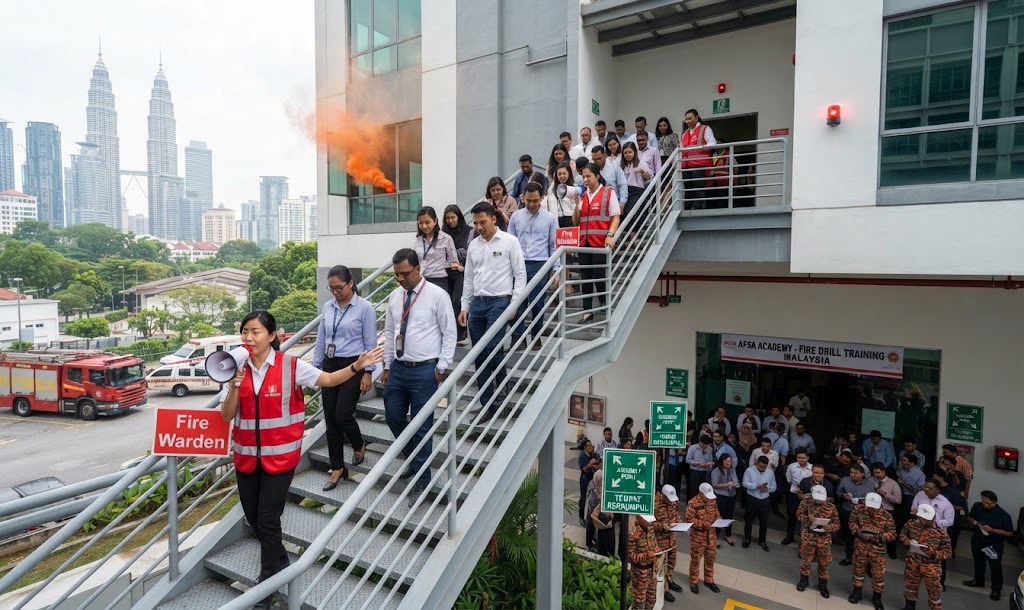
A written emergency plan alone cannot guarantee an organised response. Employees must understand the alarm, identify the correct exit and know where to gather after leaving the building.
Fire wardens and Emergency Response Team members also need practical experience. They must coordinate employee movement, assist visitors and communicate critical information during an emergency.
Therefore, organisations should conduct structured fire drills instead of treating evacuation exercises as simple compliance activities.
AFSA Academy provides practical fire safety and emergency response training for organisations in Malaysia. Its training approach combines classroom learning, practical activities and workplace emergency scenarios.
What Is Fire Drill Training Malaysia?
Fire drill training Malaysia is a planned exercise that tests how employees respond when a fire alarm or evacuation instruction occurs.
The organisation creates a controlled emergency scenario. Employees then follow the established evacuation procedure as though an actual incident has happened.
A structured fire drill may test:
- Fire alarm activation.
- Emergency communication.
- Employee response.
- Evacuation routes.
- Emergency exit accessibility.
- Fire warden coordination.
- Visitor management.
- Assembly-point control.
- Employee headcounts.
- Communication with external responders.
- Emergency Response Team performance.
A fire drill does not only test evacuation speed. It also evaluates whether employees understand their responsibilities and whether the Emergency Response Plan works under practical conditions.
The organisation should review every exercise. It must then correct weaknesses before the next emergency drill.
Why Workplace Fire Drill Training Is Important
A workplace emergency can create confusion within seconds.
Employees may stop working, collect personal belongings or wait for instructions. Some occupants may use the wrong exit, while others may not recognise the alarm.
Visitors and contractors may face greater risks because they do not know the building layout.
Regular workplace fire drill training helps organisations:
- Familiarise employees with alarm signals.
- Reinforce evacuation procedures.
- Test primary and alternative exits.
- Improve fire warden coordination.
- Prepare employees for assembly-point procedures.
- Identify communication weaknesses.
- Test employee accountability systems.
- Support visitors and contractors.
- Evaluate Emergency Response Team competency.
- Identify blocked or unsuitable escape routes.
- Strengthen overall workplace preparedness.
Practical exercises also build familiarity. Employees who understand the procedure can respond more calmly and follow instructions more effectively.
However, organisations should not repeat the same predictable drill every time. Different scenarios can reveal different weaknesses within the emergency system.
What Are the Main Objectives of a Fire Drill?
Every fire drill should have clear objectives.
Without defined objectives, the organisation may only record the evacuation time and overlook more serious weaknesses.
The main objectives may include:
- Testing whether employees recognise the fire alarm.
- Measuring the time required to evacuate.
- Checking whether employees use safe evacuation routes.
- Evaluating fire warden performance.
- Testing Emergency Response Team communication.
- Confirming that emergency exits remain accessible.
- Reviewing visitor and contractor procedures.
- Testing employee attendance records.
- Checking assembly-point management.
- Identifying employees who require additional assistance.
- Evaluating communication with emergency services.
- Recording corrective actions for future improvement.
The organisation should select objectives based on its workplace risks, building layout and previous drill findings.
For example, a high-rise office may focus on staircase control. Meanwhile, a warehouse may test evacuation around storage areas and vehicle routes.
How to Plan Fire Drill Training Malaysia
A successful drill requires proper preparation.
The planning team should avoid creating unnecessary danger or panic. It should also ensure that the exercise does not interfere with critical operations.
Review the Emergency Response Plan
First, the organisation should review its current Emergency Response Plan.
The plan should identify:
- Emergency roles and responsibilities.
- Alarm procedures.
- Contact numbers.
- Evacuation routes.
- Assembly points.
- Fire warden zones.
- Emergency equipment.
- First aid arrangements.
- Procedures for visitors.
- Support for persons who need assistance.
- Communication with external emergency services.
The official DOSH Emergency Response Plan checklist can help organisations review important emergency planning elements.
The organisation should update the plan whenever the building layout, workforce, equipment or operational risks change.
Select a Suitable Scenario
Next, the planning team should select a realistic emergency scenario.
Possible scenarios may include:
- Smoke detected in an office area.
- A fire near an electrical room.
- A small warehouse fire.
- An incident near the main exit.
- A chemical-related emergency.
- An alarm during a meeting or event.
- A fire involving a contractor’s work area.
- An emergency during a shift change.
- A blocked primary evacuation route.
The scenario should match the workplace risk profile.
However, the planning team should not create actual unsafe conditions. It must conduct the exercise within controlled limits.
Assign Observers
Appointed observers should monitor the drill without interfering unnecessarily.
Observers may record:
- The time of alarm activation.
- Employee reaction time.
- Evacuation duration.
- Use of correct exits.
- Fire warden performance.
- Communication problems.
- Unsafe behaviour.
- Assembly-point organisation.
- Employee headcount accuracy.
- Access for emergency vehicles.
- Problems involving visitors.
- Delays involving specific departments.
The organisation can place observers at key locations such as staircases, emergency exits, assembly points and high-traffic areas.
Inform Relevant Personnel
Some drills may remain unannounced to most employees. However, the organisation should inform key personnel who need to protect critical operations.
Relevant personnel may include:
- Senior management.
- Security teams.
- Building management.
- Emergency coordinators.
- Safety personnel.
- Control-room operators.
- Production supervisors.
- Neighbouring tenants.
- External emergency services, when required.
Clear planning prevents misunderstandings and reduces unnecessary disruption.
How to Conduct a Workplace Fire Drill
The organisation should conduct the exercise according to its approved emergency procedure.
Each stage should test a different part of the response system.
Activate the Alarm
The exercise normally begins when an authorised person activates the fire alarm or emergency notification.
Observers should check whether:
- Employees can hear the alarm.
- Visual alarms function where required.
- Employees recognise the signal.
- Staff stop work promptly.
- Emergency teams receive notifications.
- Public announcements remain clear.
Employees should understand that every alarm requires attention. They should not assume that an alarm is false or unimportant.
Begin the Evacuation
Employees should follow the assigned evacuation routes.
They should:
- Stop work safely.
- Leave personal belongings behind.
- Walk towards the nearest safe exit.
- Avoid using lifts.
- Follow fire warden instructions.
- Assist visitors when assigned.
- Move calmly through staircases.
- Proceed directly to the assembly point.
Employees should not return to collect phones, bags or documents.
They should also avoid blocking exits while waiting for colleagues.
Manage the Assembly Point
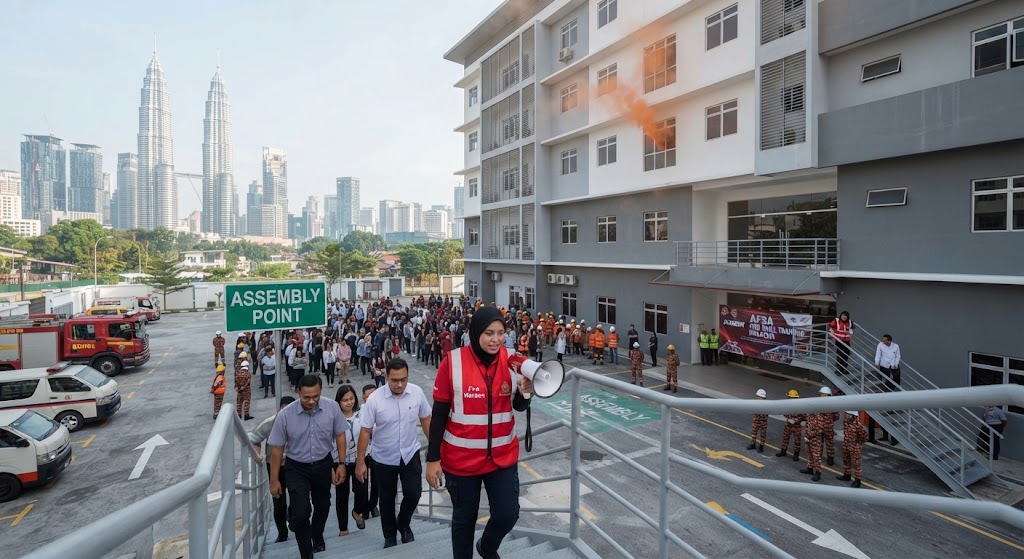
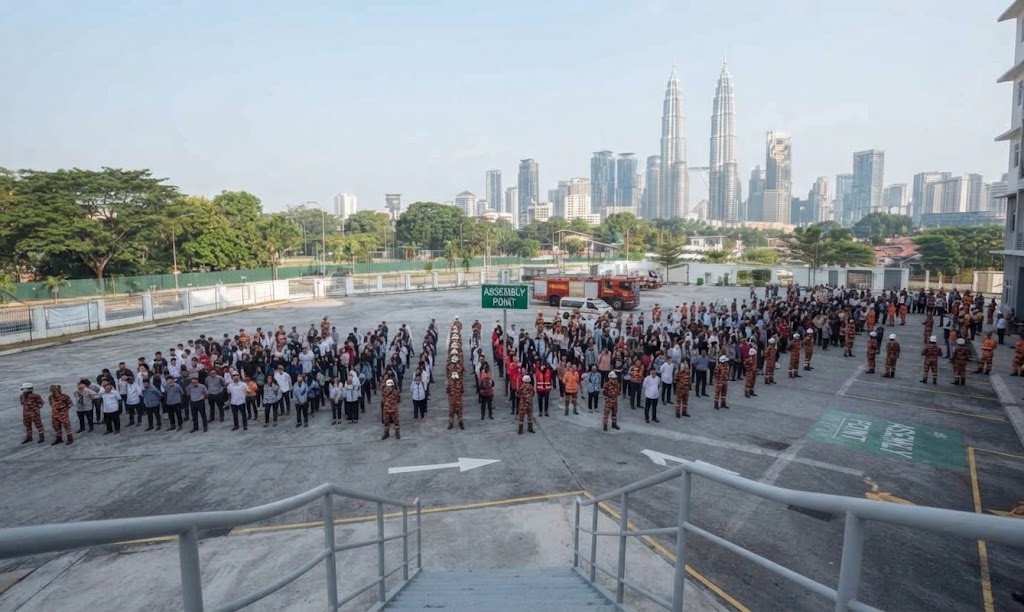
After leaving the building, employees should report to the correct assembly area.
The assembly-point team may:
- Organise employees by department.
- Conduct headcounts.
- Review visitor records.
- Record missing persons.
- Communicate results to the incident coordinator.
- Keep emergency vehicle routes clear.
- Prevent employees from leaving.
- Stop unauthorised re-entry.
A disorganised assembly point can delay employee accountability.
Therefore, organisations should assign trained personnel to manage this stage.
End the Exercise Safely
Only an authorised person should announce the end of the drill.
Employees should not re-enter the building until the organisation provides a clear all-safe instruction.
After the drill, the emergency team should confirm that:
- The building remains safe.
- All participants have been accounted for.
- Emergency systems have returned to normal.
- Operational departments can resume work.
- Observers have submitted their findings.
- The debriefing session has been scheduled.
Role of Fire Wardens During a Fire Drill
Fire wardens help coordinate evacuation within assigned floors, departments or zones.
A fire warden training course prepares selected employees to perform these responsibilities safely.
During a fire drill, a fire warden may:
- Recognise and respond to the alarm.
- Direct employees towards safe exits.
- Monitor movement through evacuation routes.
- Prevent occupants from using lifts.
- Assist visitors and contractors.
- Check assigned areas when safe.
- Report hazards or delays.
- Communicate with the emergency coordinator.
- Support employee headcounts.
- Prevent unauthorised re-entry.
Fire wardens should not place themselves at unnecessary risk.
They should not enter smoke-filled areas, delay their evacuation or conduct tasks beyond their training.
Some organisations use the term fire marshal instead of fire warden. Regardless of the title, management should clearly define each person’s responsibilities.
How ERT Training Supports Fire Drills
Fire wardens may form part of a wider Emergency Response Team.
The ERT may also include:
- An incident commander.
- Emergency coordinators.
- Communication personnel.
- Firefighting team members.
- First aiders.
- Security personnel.
- Assembly-point coordinators.
- HAZMAT response personnel.
- Rescue team members.
Structured ERT training Malaysia helps these team members work within a clear command system.
During a fire drill, the ERT should practise:
- Activating emergency procedures.
- Communicating accurate information.
- Coordinating different response groups.
- Managing evacuation.
- Assessing the simulated incident.
- Supporting first aid arrangements.
- Preparing information for external responders.
- Controlling access to the affected area.
- Recording response actions.
Organisations can explore AFSA’s emergency response and fire safety services when planning practical training for their workplace teams.
Does Fire Drill Training Include Basic Firefighting?
Some fire drill programmes include a basic firefighting component. However, evacuation and firefighting require different competencies.
A basic fire fighting training Malaysia programme may teach participants about:
- Fire behaviour.
- Common workplace fire hazards.
- Fire classifications.
- Portable fire extinguishers.
- Suitable extinguisher selection.
- Alarm activation.
- Safe approach distances.
- Escape route awareness.
- Limitations of initial firefighting.
- Safe withdrawal.
Employees should only attempt an initial response when they have received suitable training and conditions remain safe.
They must evacuate when:
- Smoke affects visibility.
- Heat becomes intense.
- The fire spreads rapidly.
- Hazardous materials become involved.
- They lack suitable equipment.
- Their escape route becomes unsafe.
- They feel uncertain about the situation.
The main objective remains protecting people. Employees should never take unnecessary risks to protect property.
Common Problems Found During Fire Drills
Fire drills often reveal issues that remain hidden during normal operations.
Common problems include:
- Employees ignoring the alarm.
- Staff delaying evacuation.
- Employees collecting personal belongings.
- Occupants using the wrong exit.
- People attempting to use lifts.
- Emergency exits remaining blocked.
- Fire doors being held open.
- Confusion inside staircases.
- Visitors receiving no assistance.
- Fire wardens giving conflicting instructions.
- Employees reporting to the wrong assembly point.
- Inaccurate attendance records.
- Poor communication between departments.
- Emergency vehicle routes being obstructed.
- Employees re-entering the building too early.
The organisation should record each issue.
Management should then assign a person, deadline and required action for every improvement.
Without follow-up, the same problems may appear during the next drill or an actual emergency.
How to Evaluate Fire Drill Performance
A fire drill evaluation should cover more than the total evacuation time.
The organisation may evaluate:
- Alarm activation time.
- Employee reaction time.
- Total evacuation time.
- Time required for headcounts.
- Number of employees using incorrect exits.
- Number of missing or unaccounted occupants.
- Fire warden response.
- Emergency communication quality.
- Visitor management.
- Exit and staircase conditions.
- ERT coordination.
- Compliance with assigned responsibilities.
- Completion of corrective actions.
Observers should provide objective findings.
The organisation should avoid blaming individual employees without understanding the underlying cause.
For example, an employee may use the wrong exit because signs remain unclear. Another department may submit an inaccurate headcount because its attendance records are outdated.
The review should identify system improvements as well as employee training needs.
What Happens After a Fire Drill?
The organisation should conduct a debriefing shortly after the exercise.
During the debrief, participants can discuss:
- What worked well.
- What caused delays.
- Which instructions created confusion.
- Whether all alarms functioned.
- Whether exits remained accessible.
- How effectively fire wardens performed.
- Whether the assembly point worked properly.
- Whether the attendance system remained accurate.
- What corrective actions the organisation needs.
- When the organisation will conduct the next exercise.
Management should document the findings in a fire drill report.
The report may include:
- Date and time.
- Emergency scenario.
- Participating departments.
- Number of participants.
- Evacuation duration.
- Observer findings.
- Photos where appropriate.
- Problems identified.
- Corrective actions.
- Responsible persons.
- Completion deadlines.
- Follow-up review dates.
A clear report creates accountability and supports continuous improvement.
How Often Should Organisations Conduct Fire Drills?
The suitable frequency depends on the organisation’s risk profile, workforce and applicable requirements.
Management should consider:
- Type of workplace.
- Number of employees.
- Building complexity.
- Shift arrangements.
- Employee turnover.
- Presence of hazardous materials.
- Changes to the workplace layout.
- Previous drill results.
- Emergency team competency.
- Requirements from relevant authorities.
- Organisational safety policies.
Organisations should also conduct additional exercises after major operational changes.
For example, a new production area, warehouse extension or office relocation may affect evacuation routes.
New employees should receive emergency information during their induction. They should not wait until the next annual exercise to learn the evacuation procedure.
Fire Drill Training for Different Industries
Every organisation faces different emergency risks.
Therefore, fire drill training Malaysia should reflect the workplace environment rather than use one generic scenario.
Offices and Commercial Buildings
Office drills may focus on:
- Staircase movement.
- Floor warden responsibilities.
- Visitor management.
- Lift restrictions.
- Assembly-point control.
- High-rise evacuation procedures.
Factories and Manufacturing Plants
Manufacturing facilities may need to test:
- Safe equipment shutdown.
- Production-area evacuation.
- Shift-worker accountability.
- Contractor management.
- High-risk process areas.
- Emergency vehicle access.
Warehouses and Logistics Centres
Warehouse exercises may focus on:
- Storage-area evacuation.
- Blocked aisle risks.
- Vehicle movement.
- Combustible materials.
- Loading-bay access.
- Temporary workers and drivers.
Chemical and High-Risk Facilities
Chemical facilities may require additional preparation for:
- Hazardous material isolation.
- Wind direction.
- Exclusion zones.
- Protective equipment.
- Spill response.
- Decontamination.
- Specialised emergency communication.
General fire safety training may not provide enough preparation for these environments.
The organisation may need additional HAZMAT and specialist emergency response training.
Hotels, Hospitals and Educational Institutions
These organisations may need to consider:
- Guests, patients or students.
- People with limited mobility.
- Large numbers of occupants.
- Night-time operations.
- Communication across different areas.
- Staff assigned to provide assistance.
The training provider should review these factors before designing the exercise.
How to Choose a Fire Drill Training Provider
Choosing a provider requires more than comparing course prices.
Organisations should review:
- Trainer experience.
- Fire safety knowledge.
- Emergency response background.
- Practical training methods.
- Scenario-design capabilities.
- Understanding of workplace risks.
- Fire drill evaluation methods.
- Training equipment.
- Participant limits.
- Corporate customisation.
- Post-training reporting.
- Certificate details.
- Refresher training options.
The provider should understand the organisation’s industry, layout and emergency structure.
A suitable provider should also explain the learning objectives before conducting the programme.
This approach allows management to measure whether the training produces practical improvements.
Why Choose AFSA Academy for Fire Drill Training?
AFSA Academy focuses on fire safety, emergency response, firefighting and HAZMAT training.
Its programmes combine theoretical learning with practical simulations. This approach helps participants understand their responsibilities and practise them within controlled scenarios.
Depending on workplace needs, organisations may combine:
- Fire drill training.
- Emergency Response Team development.
- Fire warden training.
- Fire Safety Manager training.
- Fire Safety Officer training.
- Basic firefighting.
- HAZMAT awareness.
- Rescue training.
- First aid, CPR and AED.
Companies can learn more about AFSA Academy and its approach to practical workplace training.
A combined programme can help organisations test the complete emergency system instead of training each role separately.
Conclusion
Fire drills help organisations determine whether their emergency procedures work under practical conditions.
However, simply activating an alarm and recording evacuation time does not provide a complete evaluation.
The organisation should test employee response, fire warden performance, Emergency Response Team communication, assembly-point management and employee accountability.
It should also conduct a debriefing and complete every corrective action.
Regular fire drill training Malaysia can improve employee awareness, strengthen emergency coordination and reveal weaknesses before an actual incident occurs.
Organisations can combine fire drills with fire warden, ERT, basic firefighting and HAZMAT training based on their workplace risks.
Businesses can contact AFSA Academy to discuss their workplace layout, emergency objectives, number of participants and preferred fire drill scenario.
Frequently Asked Questions
What is fire drill training Malaysia?
Fire drill training Malaysia is a controlled workplace exercise that tests alarms, evacuation routes, employee response, fire warden coordination and assembly-point procedures.
Why should organisations conduct fire drills?
Fire drills help organisations identify weaknesses, familiarise employees with evacuation procedures and evaluate the effectiveness of their Emergency Response Plan.
Who should participate in a workplace fire drill?
Employees, management, contractors, fire wardens, security personnel and Emergency Response Team members may participate based on the selected scenario.
What does a fire warden do during a fire drill?
A fire warden guides employees towards safe exits, monitors an assigned area, assists visitors and communicates information to the emergency coordinator.
Is a fire warden the same as a fire marshal?
Many organisations use the terms interchangeably. Management should clearly define the responsibilities attached to the role within its Emergency Response Plan.
Should employees know about the drill in advance?
The organisation may announce or partially announce the exercise based on its objectives. However, key personnel should understand the plan to protect critical operations and participant safety.
Does a fire drill include using fire extinguishers?
A fire drill mainly tests evacuation and coordination. Organisations may add a separate basic firefighting session when suitable trainers, equipment and controlled facilities are available.
How long should a fire drill take?
There is no single suitable duration for every workplace. The organisation should consider building size, number of occupants, employee needs and evacuation complexity.
What should the organisation evaluate after a fire drill?
The organisation should evaluate employee reaction, evacuation routes, communication, fire warden performance, assembly-point control, headcounts and corrective actions.
How often should an organisation conduct fire drill training?
The schedule should reflect workplace risks, operational changes, staff turnover, building complexity and applicable requirements.
Can a fire drill programme be customised?
Yes. The provider can design the exercise around the workplace layout, industry hazards, emergency structure and training objectives.
How can an organisation arrange fire drill training?
The organisation can contact AFSA Academy and provide information about its premises, workforce, risks and preferred training objectives.