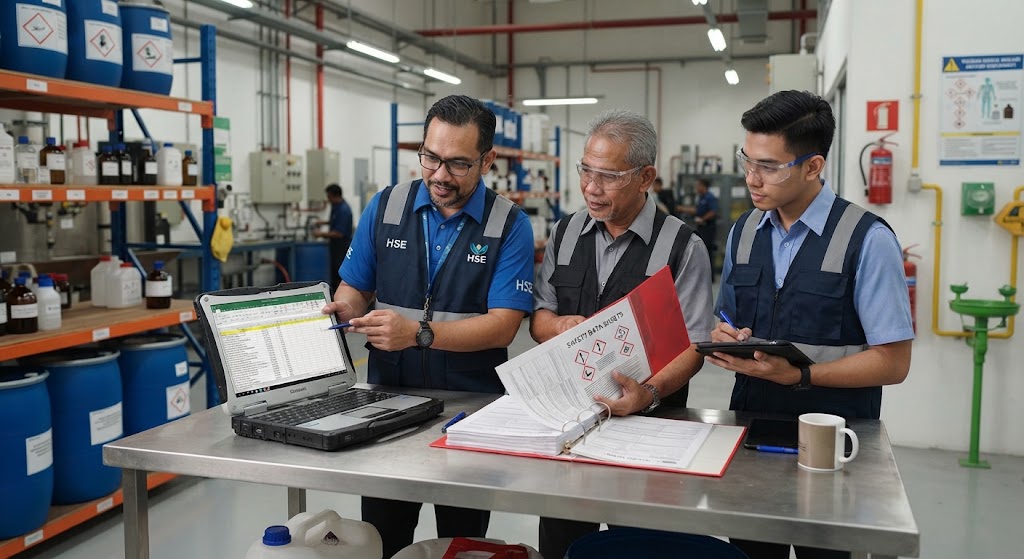
A chemical register Malaysia workplaces can rely on provides an organised record of chemicals hazardous to health that employees use, handle or store at work.
The register helps employers understand which chemicals are present, where employees use them and whether current Safety Data Sheets remain available. It also gives safety personnel and emergency teams faster access to important hazard information.
However, a chemical register should not remain as an outdated spreadsheet or a folder of unverified documents. Management must keep the information accurate, accessible and connected to actual workplace operations.
AFSA Academy supports organisations through specialised fire safety, emergency response and hazardous-material consultancy and training. Its practical approach helps industrial teams connect chemical information with workplace preparedness.
What Is a Workplace Chemical Register?
A workplace chemical register is a structured record of chemicals hazardous to health found within an organisation.
The register usually combines a chemical inventory with the relevant Safety Data Sheets for the listed products.
It helps the organisation answer several important questions:
- Which hazardous chemicals are present?
- Which department uses each product?
- Where does the organisation store it?
- Is a current Safety Data Sheet available?
- What hazards does the chemical present?
- Which employees may face exposure?
- Does the Emergency Response Team know its location?
- When did management last review the information?
Malaysia’s Department of Occupational Safety and Health states that employers must identify and register chemicals hazardous to health used at the workplace. DOSH guidance also explains that the chemical register consists of the chemical inventory and Safety Data Sheets for the listed chemicals.
Therefore, employers should treat the register as an active workplace safety tool rather than a document prepared only before an inspection.
Chemical Register and Inventory of Hazardous Materials
Organisations may use several related terms, including:
- Chemical register.
- Chemical inventory.
- Hazardous chemicals inventory.
- Inventory of Hazardous Materials.
- Register of Chemicals Hazardous to Health.
- Safety Data Sheet register.
Although the exact terminology may differ, the practical objective remains similar. The organisation needs an accurate record of hazardous products, their locations, relevant quantities and supporting hazard information.
AFSA includes Inventory of Hazard Materials within its specialised consultancy services, especially for organisations operating in higher-risk industrial environments.
However, companies should define the scope clearly before starting the project.
For example, one organisation may need a workplace chemical register under occupational safety requirements. Another may require a wider inventory covering process materials, emergency-planning quantities and site maps.
A clear scope prevents missing information and duplicated records.
Why a Chemical Register Malaysia Workplaces Use Is Important
Hazardous chemicals can move between departments, stores and production areas.
Employees may introduce a new cleaning product, maintenance chemical or process material without updating the central record. Meanwhile, suppliers may revise labels or Safety Data Sheets.
Consequently, the organisation may lose track of:
- Products currently in use.
- Chemicals no longer required.
- Expired or obsolete materials.
- Missing Safety Data Sheets.
- Unlabelled containers.
- Different products with similar names.
- Chemicals stored in temporary locations.
- New hazards introduced into a work process.
A reliable chemical register helps organisations:
- Identify workplace chemical hazards.
- Support Chemical Health Risk Assessment activities.
- Improve employee hazard communication.
- Review chemical-storage arrangements.
- Prepare emergency-response procedures.
- Locate Safety Data Sheets quickly.
- Monitor product changes.
- Improve contractor control.
- Support workplace inspections.
- Plan suitable training and PPE assessments.
Moreover, an accurate inventory can help management reduce unnecessary chemical holdings.
The organisation may discover duplicate products, unused stock or materials that departments no longer need.
Understanding USECHH and CLASS Responsibilities
Employers should understand the difference between workplace-use responsibilities and supplier responsibilities.
The USECHH Regulations 2000 address chemicals hazardous to health used at the workplace. DOSH states that employers must identify these chemicals and record them in a register that authorised officers can access.
Meanwhile, the CLASS Regulations 2013 cover areas such as classification, packaging, labelling, Safety Data Sheets and hazardous-chemical inventory responsibilities for relevant suppliers.
Therefore, an employer that uses chemicals and a company that manufactures or imports hazardous chemicals may have different responsibilities.
Management should identify whether the organisation acts as:
- A workplace employer using chemicals.
- A chemical manufacturer.
- A chemical importer.
- A distributor or supplier.
- A combination of these roles.
The organisation should obtain competent advice when it needs confirmation about its specific legal duties.
What Information Should a Chemical Register Include?
The exact format may depend on the workplace and assessment requirements. However, a practical register should allow safety personnel to identify each product and locate its supporting information.
Useful fields may include:
- Product or chemical name.
- Supplier or manufacturer.
- Product identifier.
- Department or work activity.
- Storage or usage location.
- General quantity or quantity range.
- Physical form.
- Hazard classification.
- Current Safety Data Sheet status.
- SDS revision date.
- Employees or work groups involved.
- Existing risk assessment reference.
- Responsible department.
- Register review date.
- Notes on discontinued or replaced products.
The product name in the register should match the identifier shown on the label and Safety Data Sheet.
This consistency reduces confusion when employees, assessors or emergency responders need information quickly.
Chemical Register Malaysia and Safety Data Sheets
A Safety Data Sheet provides essential information about a hazardous chemical.
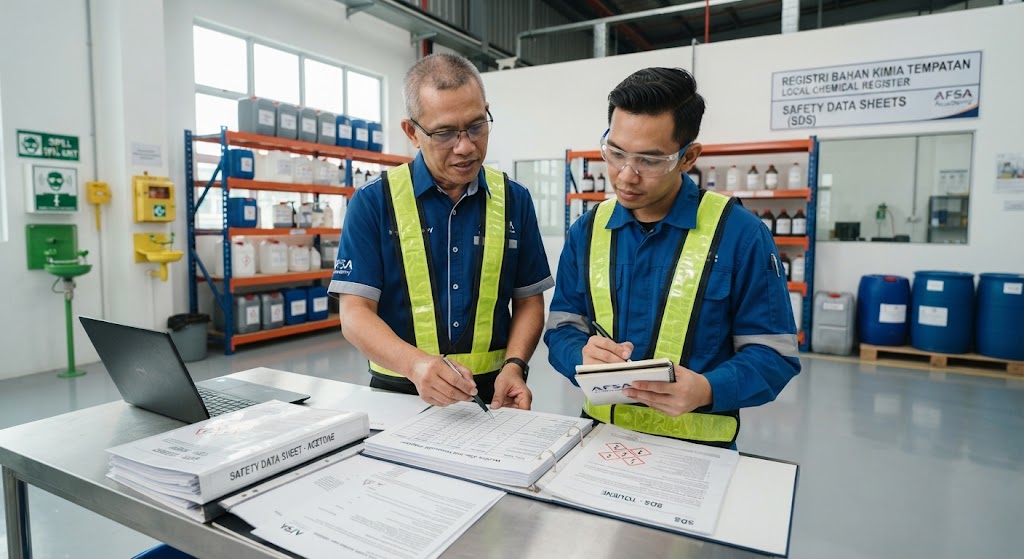
Depending on the product, it may include information about:
- Product identification.
- Hazard classification.
- Ingredients.
- First-aid considerations.
- Fire-related hazards.
- Accidental-release considerations.
- Handling and storage.
- Exposure controls.
- Personal protective equipment.
- Physical and chemical properties.
- Stability and reactivity.
- Disposal and transport information.
However, keeping an SDS folder does not automatically create an effective chemical register.
Management should confirm that:
- Every listed chemical has the correct SDS.
- The product identifier matches the container label.
- The document reflects the current supplier.
- Employees can access the information.
- The organisation removes documents for obsolete products.
- The register shows the correct usage location.
- Relevant personnel understand how to find the information.
The DOSH chemical-management portal provides official information on the USECHH framework, chemical registers and Chemical Health Risk Assessments.
Step 1: Define the Chemical Register Scope
First, management should define which premises, departments and activities the register will cover.
The scope may include:
- One workplace.
- Several buildings within the same site.
- Production areas.
- Warehouses.
- Maintenance workshops.
- Laboratories.
- Cleaning and housekeeping stores.
- Utility areas.
- Contractor-controlled locations.
- Temporary project areas.
Large sites may need a central master register supported by department-level inventories.
This arrangement helps management maintain an overall view while allowing supervisors to monitor chemicals in their own work areas.
The organisation should also decide who owns the register.
Possible responsible personnel may include:
- Safety and Health Officers.
- OSH coordinators.
- Chemical-management personnel.
- Facility managers.
- HSE managers.
- Department supervisors.
- Warehouse representatives.
- Laboratory managers.
One person should coordinate the master record. However, each department should remain responsible for reporting changes.
Step 2: Conduct a Physical Workplace Survey
Next, the organisation should inspect actual work areas.
The survey team should not depend entirely on purchasing records because employees may keep products in cabinets, workshops, vehicles or temporary stores.
The team may inspect:
- Chemical stores.
- Production lines.
- Maintenance rooms.
- Laboratories.
- Cleaning cupboards.
- Warehouses.
- Utility areas.
- Waste-holding areas.
- Contractor work zones.
- Employee workstations where relevant.
During the survey, the team should record the product identifier, supplier, location and current usage status.
It should also note visible issues such as:
- Missing labels.
- Damaged containers.
- Unknown products.
- Products not found in the existing register.
- Obsolete stock.
- Chemicals stored in unexpected locations.
- Missing or inaccessible Safety Data Sheets.
The team should refer uncertain products to competent personnel instead of making assumptions about their identity.
Step 3: Collect and Verify Current Safety Data Sheets
After identifying the products, the organisation should collect the correct Safety Data Sheet for each chemical.
Management may obtain the document from the supplier or manufacturer.
The review should confirm:
- The product name matches the label.
- The supplier information remains relevant.
- The SDS covers the correct product formulation.
- The document remains readable.
- Employees can access it.
- Relevant language requirements have been considered.
- The register records the document’s revision date.
A common mistake involves downloading a Safety Data Sheet for a similarly named product from a different manufacturer.
However, products with similar names may contain different ingredients or classifications.
Therefore, the organisation should match each SDS with the actual supplied product.
Step 4: Standardise Product Names and Locations
Different employees may refer to the same chemical using shortened names, internal codes or informal descriptions.
This practice can create duplicate entries.
For example, purchasing records may use a supplier’s full product name, while production employees use an internal abbreviation.
The register should establish one standard product identifier and record any approved internal reference separately.
Management should also standardise workplace locations.
Instead of entering vague descriptions such as “factory” or “store,” the register may use clearer location references such as:
- Chemical Store A.
- Production Line 2.
- Maintenance Workshop.
- Laboratory Room 1.
- Waste Holding Area.
- Utility Building.
Clear location data improves inspections and emergency planning.
Step 5: Record How the Workplace Uses Each Product
A chemical’s risk depends partly on how employees use it.
Therefore, the register should link each product with the relevant work activity.
Examples may include:
- Cleaning.
- Equipment maintenance.
- Production processing.
- Laboratory testing.
- Surface preparation.
- Water treatment.
- Facility operations.
- Waste handling.
The register does not replace a Chemical Health Risk Assessment. However, it provides important information for identifying work activities that may require further assessment.
Management should also identify which departments, shifts or contractors use each product.
This information helps the organisation plan communication, training and workplace monitoring.
Step 6: Connect the Register With CHRA
A Chemical Health Risk Assessment evaluates health risks arising from workplace use, handling, storage or transport of chemicals hazardous to health.
The chemical register provides a starting point for this process because it identifies the products and activities that require review.
However, the register and CHRA serve different purposes.
The chemical register records what is present.
The CHRA evaluates how workplace activities may expose employees and whether existing controls remain adequate.
Therefore, management should ensure that:
- The CHRA uses the current chemical list.
- New products trigger a review.
- Discontinued chemicals receive proper status updates.
- Work-process changes reach the assessor.
- Corrective actions receive follow-up.
- The register references relevant assessment reports.
The official DOSH chemical-management resources provide guidance on chemical registers, USECHH and Chemical Health Risk Assessments.
Step 7: Link the Register With Emergency Response Planning
An accurate chemical register supports the Emergency Response Team during fires, leaks and other hazardous-material incidents.
The team may need to identify:
- The product involved.
- Its location.
- Available Safety Data Sheet information.
- Nearby materials.
- Employees who may be affected.
- Relevant emergency contacts.
- Restricted areas.
- Suitable external specialist support.
Therefore, safety personnel should ensure that relevant emergency information remains accessible even when normal office systems become unavailable.
The organisation may provide controlled access through:
- A digital safety-management system.
- A secure shared drive.
- Department copies.
- A security control room.
- An emergency-information folder.
- Approved mobile access.
- A designated incident-command location.
AFSA’s Emergency Response Team training helps workplace teams strengthen incident communication, evacuation and coordination.
Meanwhile, its HAZMAT training programme supports hazardous-material identification, SDS awareness and initial emergency preparedness.
Step 8: Review Storage and Segregation Information
The register can help management identify where the workplace stores hazardous materials.
However, employees should not use the register alone to make technical storage decisions.
Competent personnel should review the relevant Safety Data Sheets, workplace assessment and storage guidance.
The organisation should consider whether:
- Storage areas remain clearly identified.
- Containers carry suitable labels.
- Employees keep incompatible materials appropriately separated.
- Access remains controlled.
- Emergency equipment remains available.
- Spill or fire procedures reflect the materials present.
- Storage quantities match operational needs.
- Waste materials receive proper management.
DOSH guidance explains that hazardous-chemical storage can create risks to employees, emergency services, the public and the environment, particularly when fire or harmful fumes become involved.
Step 9: Make the Register Accessible
A chemical register provides little value when employees cannot find it.
The organisation should identify who needs access and how they will obtain it.
Relevant users may include:
- Employees using the chemicals.
- Safety personnel.
- Department supervisors.
- First aiders.
- Emergency Response Team members.
- Fire wardens.
- Occupational health personnel.
- Assessors.
- Authorised enforcement officers.
The register should remain controlled but accessible.
Management should avoid keeping the only copy inside a locked office that becomes unavailable during an emergency.
Digital systems can improve accessibility. Nevertheless, organisations should consider backup arrangements for power, network or system failures.
Step 10: Establish an Updating Procedure
The chemical register must reflect actual workplace conditions.
Therefore, management should establish clear update triggers.
The organisation should review the register when:
- A department purchases a new chemical.
- The supplier changes.
- A product formulation changes.
- A new Safety Data Sheet becomes available.
- The workplace relocates the product.
- Usage quantities change significantly.
- A work process changes.
- The organisation discontinues a product.
- A department transfers stock.
- An incident or inspection identifies an error.
- The CHRA requires an update.
Purchasing, stores, safety personnel and department supervisors should communicate these changes.
Without a defined workflow, employees may introduce new chemicals before the safety team receives the necessary information.
Creating a Chemical Approval Workflow
A simple approval workflow can prevent uncontrolled chemical introduction.
Before purchasing or using a new chemical, the responsible department may need to provide:
- The product name.
- Supplier information.
- Current Safety Data Sheet.
- Intended use.
- Proposed location.
- Expected users.
- Reason for introduction.
- Existing alternative products.
- Required risk assessment.
- Required training or controls.
Safety personnel can then review whether the organisation already uses a suitable alternative.
This process may reduce duplicate products and unnecessary chemical variety.
However, the workflow should remain practical. An overly complicated process may encourage departments to bypass it.
Common Chemical Register Mistakes
Organisations should avoid several common weaknesses.
Keeping SDS Documents Without an Inventory
A folder of Safety Data Sheets does not show which products remain in use or where employees store them.
Depending Only on Purchasing Records
Purchasing records may not reflect chemicals held in workshops, vehicles or temporary work areas.
Using Different Names for the Same Product
Inconsistent naming creates duplicate entries and confusion.
Failing to Remove Obsolete Products
The register should clearly identify discontinued products and confirm whether stock remains on-site.
Recording Vague Locations
A clear department or storage location provides more value than a general site description.
Missing Supplier Changes
A new supplier may provide a different product formulation or revised SDS.
Excluding Contractor Chemicals
Contractors may bring hazardous products into the workplace. The organisation should define how it records and controls them.
Failing to Update Emergency Teams
ERT members may use outdated information when the register does not reflect current locations or products.
Chemical Register Checklist
Management can use this simplified checklist during a review.

Inventory Information
- Every workplace area has been surveyed.
- Product names match container labels.
- Departments and locations remain accurate.
- Obsolete products have been identified.
- Contractor chemicals receive suitable control.
Safety Data Sheets
- Every listed chemical has the correct SDS.
- Supplier and product details match.
- Documents remain readable and accessible.
- Revision dates have been recorded.
- Old or incorrect documents have been removed.
Workplace Management
- One person coordinates the master register.
- Departments report new chemicals.
- Purchasing follows an approval process.
- CHRA documents use the current inventory.
- Emergency teams can access relevant information.
- Management reviews the register regularly.
Industries That Need a Strong Chemical Register
Many industries use chemicals during normal operations.
Relevant workplaces may include:
- Chemical and petrochemical facilities.
- Oil and gas operations.
- Manufacturing plants.
- Warehouses and logistics centres.
- Laboratories.
- Healthcare facilities.
- Water-treatment operations.
- Food-processing plants.
- Automotive workshops.
- Construction companies.
- Hotels and commercial buildings.
- Cleaning and facility-management providers.
Even an office may use cleaning chemicals, maintenance products or fuels for emergency equipment.
Therefore, management should assess the actual workplace rather than assume that chemical registers apply only to heavy industry.
Who Should Manage the Chemical Register?
The organisation should appoint someone with enough authority and access to coordinate the process.
Suitable personnel may include:
- Safety and Health Officers.
- OSH coordinators.
- HSE managers.
- Chemical-management personnel.
- Laboratory managers.
- Facility managers.
- Trained department representatives.
However, one person cannot maintain an accurate register without support.
Purchasing teams should report new products. Stores personnel should report stock and location changes. Supervisors should confirm actual usage, while safety personnel should coordinate assessment and documentation.
Therefore, chemical-register management should become a shared organisational process with one clear owner.
When Should an Organisation Seek Professional Support?
An organisation may need professional support when:
- The site contains many chemicals.
- Records remain incomplete.
- Several departments use different naming systems.
- Safety Data Sheets are missing or outdated.
- The organisation has introduced new processes.
- Chemical storage has expanded.
- CHRA preparation requires an updated inventory.
- Emergency teams lack accurate hazard information.
- Management plans a wider HSE audit.
- The workplace operates in a higher-risk industry.
A consultant can help structure the inventory, identify information gaps and connect the register with risk assessment and emergency planning.
However, the workplace should remain involved. Employees and supervisors understand the daily processes, locations and product usage that an external consultant may not immediately see.
Why Choose AFSA Academy?
AFSA Academy supports commercial and industrial organisations through practical safety training and specialised consultancy.
Its service scope includes:
- Inventory of Hazard Materials.
- Fire risk assessment.
- HAZMAT preparation.
- Emergency Response Team development.
- Workplace emergency planning.
- Practical safety training for higher-risk industries.
This integrated approach helps organisations connect documentation with employee competency and emergency readiness.
For example, AFSA can support HAZMAT awareness after the organisation has identified its chemical inventory and emergency-response gaps.
Companies can review AFSA’s specialised consultancy and training services before discussing a suitable programme.
Conclusion
An accurate chemical register helps employers understand which hazardous chemicals employees use, where they are located and whether current Safety Data Sheets remain available.
First, the organisation should define the scope and inspect actual workplace areas.
Next, management should verify product identifiers, collect the correct Safety Data Sheets and standardise locations.
The organisation should then connect the register with CHRA, chemical-storage reviews and Emergency Response Team planning.
Finally, management should establish a clear process for approving new products and updating workplace records.
A chemical register Malaysia workplaces can depend on must remain accurate, accessible and connected to daily operations.
Organisations that need support can contact AFSA Academy to discuss hazardous-material inventories, workplace risks, HAZMAT training and emergency-response preparation.
Frequently Asked Questions
What is a chemical register Malaysia workplaces should maintain?
A chemical register records chemicals hazardous to health used at the workplace and links them with relevant inventory information and Safety Data Sheets.
Is a chemical inventory the same as a chemical register?
The inventory normally lists the chemicals. The complete register also includes or links to the relevant Safety Data Sheets and supporting information.
Who is responsible for maintaining the chemical register?
The employer should assign a suitable person to coordinate it. However, purchasing, stores, supervisors and safety personnel should support the updating process.
Does every chemical need to appear in the register?
The organisation should identify chemicals hazardous to health that fall within the applicable workplace requirements. Competent personnel should review uncertain products.
Should cleaning chemicals appear in the register?
They may need to appear when they meet the relevant hazardous-to-health criteria. The organisation should review the product label and Safety Data Sheet.
What information should the chemical inventory contain?
It may include the product name, supplier, department, location, quantity information, hazard classification, SDS status and review date.
How often should management update the register?
Management should update it whenever products, suppliers, locations, quantities or work processes change. It should also conduct regular scheduled reviews.
Is a Safety Data Sheet folder enough?
No. A folder alone may not show which products remain in use, their locations or whether the documents match the actual supplied products.
How does a chemical register support CHRA?
It identifies the products and activities that the Chemical Health Risk Assessment may need to evaluate.
How does the register help the Emergency Response Team?
It helps the team identify the product involved, its location and relevant hazard information during an emergency.
Should contractor chemicals appear in the workplace system?
The organisation should establish a suitable process for identifying and controlling hazardous products that contractors bring onto the premises.
Can AFSA assist with hazardous-material inventories?
AFSA includes Inventory of Hazard Materials within its specialised consultancy services and can connect the findings with HAZMAT and emergency-response training.
How can an organisation discuss its chemical-register requirements?
The organisation can contact AFSA Academy with information about its industry, premises, chemical use, existing records and required project scope.