
A fire risk assessment Malaysia workplaces can apply helps organisations identify fire hazards, determine who may face danger and introduce suitable control measures.
Fire alarms, extinguishers and emergency exits form important parts of workplace protection. However, organisations must first understand where a fire could start, how it may spread and how the incident could affect employees, visitors and business operations.
Without a structured assessment, management may overlook blocked escape routes, unsafe storage, damaged electrical equipment or weaknesses within the Emergency Response Plan.
Therefore, organisations should treat fire risk assessment as an active management process rather than a document prepared only for an audit.
AFSA Academy supports commercial and industrial organisations through fire safety training, workplace inspections, risk assessment preparation and emergency-response development.
What Is a Workplace Fire Risk Assessment?
A workplace fire risk assessment is a systematic review of fire hazards, exposed people and existing safety controls.
The assessment helps an organisation answer several important questions:
- What could start a fire?
- Which materials could allow it to spread?
- Who may face the greatest risk?
- Can employees evacuate safely?
- Are existing controls effective?
- What additional improvements does the workplace need?
- Who will complete each corrective action?
- When should the organisation review the assessment again?
A useful assessment should reflect actual workplace conditions.
Management should not copy a generic template and assume that it covers every risk. An office, warehouse, factory, hotel and chemical facility will each require a different assessment.
The Department of Occupational Safety and Health defines risk assessment as evaluating workplace risks arising from identified hazards. Its HIRARC guidance uses a structured process involving hazard identification, risk evaluation, control measures and review.
Why Fire Risk Assessment Matters
Fire hazards often develop gradually during daily operations.
Employees may temporarily place boxes inside an escape route. A department may add electrical equipment without reviewing the available power supply. Contractors may introduce hot work, chemicals or temporary cables.
These changes may appear small. However, they can increase the likelihood or consequences of a fire.
A structured fire safety risk assessment helps an organisation:
- Identify hazards before an emergency occurs.
- Prioritise higher-risk problems.
- Protect employees, visitors and contractors.
- Improve fire prevention measures.
- Review emergency exits and evacuation routes.
- Support Fire Safety Managers and Fire Safety Officers.
- Strengthen the Emergency Response Plan.
- Plan employee training.
- Improve fire drill scenarios.
- Track corrective actions.
- Provide management with clearer safety information.
The assessment also allows management to allocate resources according to risk.
For example, the organisation may need to correct a blocked emergency exit immediately. Meanwhile, it may schedule lower-priority improvements within an agreed period.
Who Should Conduct the Assessment?
The organisation should involve people who understand the workplace, its operations and its fire safety arrangements.
The assessment team may include:
- Fire Safety Managers.
- Fire Safety Officers.
- Safety and Health Officers.
- OSH coordinators.
- Facility managers.
- Building managers.
- Maintenance personnel.
- Security representatives.
- Emergency Response Team leaders.
- Department supervisors.
- Production personnel.
- Warehouse representatives.
- Chemical safety specialists where relevant.
A competent external consultant may also support the assessment, particularly for complex premises or higher-risk operations.
However, workplace representatives should remain involved.
An external assessor needs accurate information about processes, operating hours, occupancy, materials and previous incidents. Employees who work in the area may also notice practical hazards that management does not see during a short inspection.
AFSA’s specialised fire safety services include fire risk assessment support for commercial and industrial organisations.
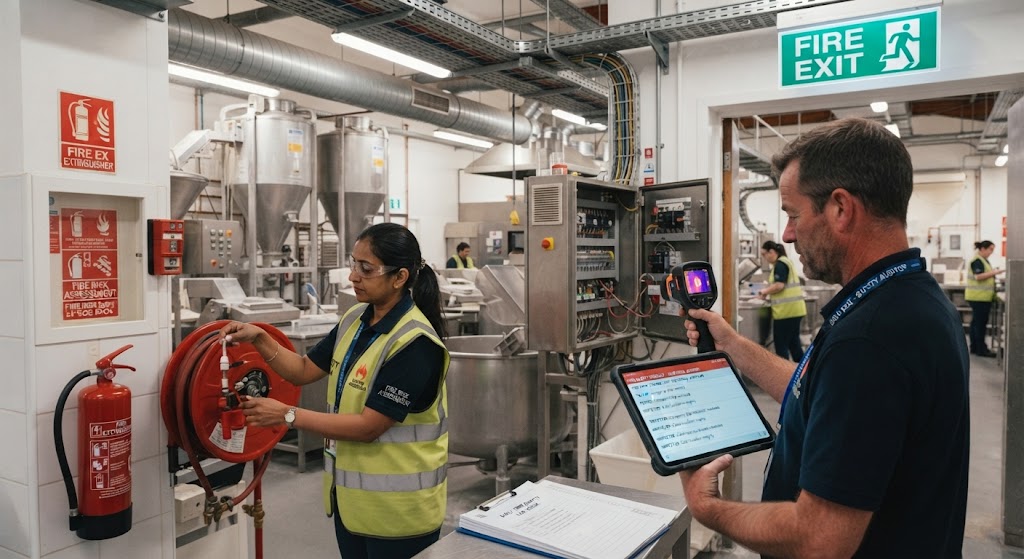
Step 1: Define the Scope of the Assessment
First, the organisation should define what the assessment will cover.
The scope may include:
- The entire workplace.
- One building or floor.
- A production department.
- A warehouse.
- A chemical storage area.
- A renovation project.
- A new process or machine.
- A temporary event.
- Contractor work.
- Night-shift operations.
Large or complex premises may require several assessments.
For example, a factory may assess its production area, warehouse, offices, chemical store and utility rooms separately. The organisation can then combine the findings within one overall fire safety programme.
The assessment should also cover normal operations and less common conditions.
These may include:
- Maintenance work.
- Equipment shutdown.
- Deliveries.
- Peak occupancy.
- Staff shortages.
- Night shifts.
- Contractor activities.
- Temporary storage.
- Renovation work.
A fire may occur when the workplace does not operate under normal conditions. Therefore, the assessment should not focus only on a typical working day.
Step 2: Identify Potential Ignition Sources
An ignition source provides enough heat or energy to start a fire.
The assessment team should inspect each work area and identify possible sources.
Common ignition sources may include:
- Electrical faults.
- Damaged cables.
- Overloaded sockets.
- Hot surfaces.
- Machinery overheating.
- Welding and cutting activities.
- Open flames.
- Cooking equipment.
- Smoking materials.
- Static electricity.
- Sparks from equipment.
- Portable heaters.
- Battery-charging stations.
- Vehicle engines.
- Uncontrolled hot work.
The assessor should also review temporary ignition sources.
Contractors may bring welding equipment, extension cables or portable machinery into the workplace. These activities can introduce new risks that the normal workplace assessment does not cover.
Management should control these activities through suitable procedures, supervision and permit systems where applicable.
Step 3: Identify Fuel and Combustible Materials
A fire also requires material that can burn.
The assessment should identify combustible and flammable materials within each area.
Examples may include:
- Paper and cardboard.
- Packaging materials.
- Furniture.
- Textiles.
- Timber.
- Plastics.
- Waste materials.
- Flammable liquids.
- Fuels and oils.
- Cleaning products.
- Chemicals.
- Gas cylinders.
- Production materials.
- Dust or fine particles.
- Stored goods.
The assessor should review both the material and its storage arrangement.
A small quantity stored correctly may create a lower risk than a large amount placed near an ignition source.
The team should ask:
- Does the workplace need to keep this quantity?
- Can the organisation reduce unnecessary stock?
- Does the material have suitable storage?
- Is it close to heat or electrical equipment?
- Can a leak or spill occur?
- Are waste materials removed regularly?
- Are containers labelled and secured?
- Are incompatible materials separated?
Good storage and housekeeping can reduce the opportunity for a fire to start or spread.
Step 4: Review Oxygen and Fire-Spreading Conditions
Normal air contains oxygen that supports combustion. However, some workplace conditions may increase the intensity or spread of a fire.
The assessment should review:
- Compressed oxygen cylinders.
- Oxidising chemicals.
- Ventilation systems.
- Open doors.
- Unsealed wall openings.
- Vertical shafts.
- Ceiling voids.
- Cable penetrations.
- Ducting.
- Combustible wall or ceiling materials.
The team should also examine fire doors and compartmentation.
A damaged or incorrectly held-open fire door may allow smoke and heat to spread into another area.
Specialist personnel may need to inspect building fire protection features. The workplace team should still report visible problems such as damaged doors, missing seals or obstructed closing mechanisms.
Step 5: Identify People at Risk
The assessment should identify everyone who may be present during an emergency.
This group may include:
- Employees.
- Contractors.
- Visitors.
- Customers.
- Students.
- Patients.
- Hotel guests.
- Delivery drivers.
- Temporary workers.
- Members of the public.
Some people may require additional assistance.
They may include:
- People with limited mobility.
- Individuals with hearing or visual difficulties.
- Pregnant employees.
- Elderly visitors.
- People recovering from injuries.
- New employees.
- Visitors unfamiliar with the premises.
- Employees working alone.
- Night-shift workers.
- Contractors working in isolated areas.
The organisation should not wait until an emergency to decide how it will assist these occupants.
Management should assign responsibilities, prepare suitable routes and communicate the arrangements to relevant employees.
Step 6: Assess the Likelihood and Possible Consequences
After identifying the hazards, the team should evaluate the level of risk.
A common approach considers:
- The likelihood of an incident occurring.
- The severity of the possible consequences.
DOSH’s HIRARC framework describes risk as a combination of likelihood and severity. Organisations can use a suitable risk matrix to prioritise identified hazards and control actions.
For example:
Lower likelihood and lower consequence
A small quantity of ordinary office materials remains stored correctly and away from ignition sources.
Higher likelihood or serious consequence
Large amounts of combustible packaging remain beside electrical charging equipment within a busy warehouse.
The organisation should use a consistent scoring method. However, the score should support decision-making rather than replace professional judgement.
A low numerical score does not justify ignoring an obvious problem.
Step 7: Evaluate Existing Fire Prevention Controls
The assessment team should review the controls already in place.
Existing fire prevention measures may include:
- Electrical maintenance.
- Equipment inspections.
- Hot-work controls.
- Chemical storage procedures.
- Smoking restrictions.
- Good housekeeping.
- Waste-removal schedules.
- Contractor supervision.
- Equipment shutdown procedures.
- Flammable-material controls.
- Staff training.
- Routine workplace inspections.
The team should confirm whether employees actually follow these controls.
A procedure may appear effective on paper but fail during daily operations.
For example, the organisation may require workers to keep exits clear. However, employees may continue using the route as a temporary storage area.
The assessment should identify this gap and recommend a practical solution.
Step 8: Review Fire Detection and Alarm Arrangements
Early warning allows employees to start evacuation sooner.
The assessment should review visible and operational aspects of the workplace alarm arrangements, including:
- Alarm call points.
- Smoke or heat detection.
- Alarm audibility.
- Visual warning devices where required.
- Public announcement systems.
- Alarm-testing arrangements.
- Emergency contact procedures.
- Reporting methods.
- Coverage during all operating shifts.
Employees should know how to report a fire and activate the workplace procedure.
The organisation should pay particular attention to:
- Noisy production areas.
- Isolated rooms.
- Outdoor work areas.
- Employees wearing hearing protection.
- Night-shift operations.
- Large warehouses.
- Areas with many visitors.
Qualified personnel should inspect and maintain technical fire detection systems.
Step 9: Review Escape Routes and Emergency Exits
A safe evacuation route should remain available whenever the workplace is occupied.
The assessment should review:
- Number and location of exits.
- Travel distance.
- Route width.
- Emergency lighting.
- Directional signs.
- Staircases.
- Exit-door operation.
- Fire doors.
- Alternative routes.
- Outdoor pathways.
- Assembly-point access.
- Obstructions.
The assessment should also consider how conditions may change.
Storage, furniture, machinery, parked vehicles or renovation work may obstruct a route that appeared clear during the original building design.
Employees must not depend on one route when a fire could affect that area.
The Emergency Response Plan should identify primary and alternative evacuation arrangements.
Step 10: Review Firefighting Equipment
The assessment should identify available workplace firefighting equipment and confirm that employees can access it.
Equipment may include:
- Portable fire extinguishers.
- Fire hose reels.
- Hydrant systems.
- Sprinklers.
- Fire blankets.
- Fixed suppression systems.
- Specialised chemical-response equipment.
The assessor should check for visible issues such as:
- Blocked access.
- Missing signs.
- Damaged equipment.
- Incorrect placement.
- Unauthorised movement.
- Poor housekeeping around the equipment.
- Overdue inspection indicators.
Authorised service providers should perform formal inspections, testing and maintenance.
Employees should only use firefighting equipment when they have suitable training, the organisation permits the action and conditions remain safe.
AFSA’s Emergency Response Team training combines incident command, extinguisher awareness, hydrant operations and evacuation-related exercises for workplace response teams.
Step 11: Review the Emergency Response Plan
A fire risk assessment should connect directly with the workplace Emergency Response Plan.
The plan should cover:
- Alarm activation.
- Emergency communication.
- Incident command.
- Evacuation routes.
- Fire warden responsibilities.
- Visitor assistance.
- Assembly-point procedures.
- Employee headcounts.
- First aid.
- Contact with emergency services.
- Re-entry control.
- Post-incident reporting.
The assessment may reveal that the plan no longer reflects actual workplace conditions.
For example:
- A department has moved.
- An assembly point is no longer suitable.
- Fire wardens have left the organisation.
- Emergency telephone numbers have changed.
- Renovation has altered an evacuation route.
- New chemicals require different procedures.
Management should update the plan whenever the assessment identifies these changes.
DOSH guidance recommends regular emergency exercises, equipment testing, post-exercise evaluation and reviews following organisational changes or identified deficiencies.
Step 12: Select Suitable Risk Control Measures
After evaluating the risks, the organisation should select practical control measures.
Possible fire risk control measures may include:
- Removing unnecessary combustible materials.
- Replacing damaged electrical equipment.
- Separating ignition sources from fuel.
- Improving chemical storage.
- Introducing safer work procedures.
- Controlling hot work.
- Improving ventilation where appropriate.
- Repairing fire doors.
- Clearing emergency exits.
- Installing clearer signs.
- Increasing inspection frequency.
- Improving contractor controls.
- Training employees.
- Conducting fire drills.
- Updating the Emergency Response Plan.
- Appointing additional fire wardens.
The organisation should prioritise controls that remove or reduce the hazard rather than depend only on warnings and employee behaviour.
For example, creating a designated storage area provides a stronger long-term solution than repeatedly telling employees not to place boxes inside an exit route.
Step 13: Record the Findings
The organisation should document significant findings and required actions.
A fire risk assessment report may include:
- Assessment date.
- Workplace or area assessed.
- Names of assessors.
- Activities covered.
- People at risk.
- Hazards identified.
- Existing controls.
- Risk level.
- Additional controls required.
- Responsible person.
- Completion deadline.
- Verification status.
- Review date.
Photographs can support the findings where appropriate.
The report should remain clear enough for management and responsible departments to understand.
Complicated technical language may prevent employees from acting on the recommendations.
Step 14: Develop a Corrective Action Plan
The assessment creates value only when the organisation completes the improvements.
A corrective action plan should identify:
- The problem.
- Required action.
- Priority level.
- Responsible department.
- Responsible person.
- Completion deadline.
- Resources required.
- Verification method.
- Final status.
Management should monitor overdue actions.
High-risk findings may require immediate controls before normal work continues. Lower-risk findings may follow an agreed improvement schedule.
The organisation should also investigate repeated issues.
When employees repeatedly block the same route, the problem may involve limited storage space, poor workflow or insufficient supervision.
Addressing the root cause produces a more sustainable solution.
Step 15: Communicate and Train Employees
Employees need information that relates to their work area and responsibilities.
The organisation may communicate assessment findings through:
- Safety briefings.
- Toolbox meetings.
- Induction programmes.
- Department meetings.
- Fire warden training.
- Emergency Response Team training.
- Updated signs.
- Evacuation maps.
- Fire drills.
- Digital workplace notices.
General employees should understand:
- Common fire hazards.
- How to report an issue.
- Alarm signals.
- Evacuation routes.
- Assembly points.
- Fire warden instructions.
- Actions they must avoid.
- Re-entry procedures.
Managers and supervisors should understand the corrective actions assigned to their departments.
When Should the Organisation Review the Assessment?
A fire risk assessment should not remain unchanged for years.
The organisation should review it:
- According to a scheduled review date.
- After a fire or near miss.
- After a fire drill identifies weaknesses.
- Following renovation or expansion.
- When the workplace layout changes.
- After installing new machinery.
- When introducing new chemicals.
- When occupancy increases.
- When work processes change.
- After changing emergency routes.
- When regulatory or internal requirements change.
The review should determine whether the hazards, risk levels and control measures remain accurate.
Management should also confirm that previous corrective actions continue working effectively.
Fire Risk Assessment Checklist
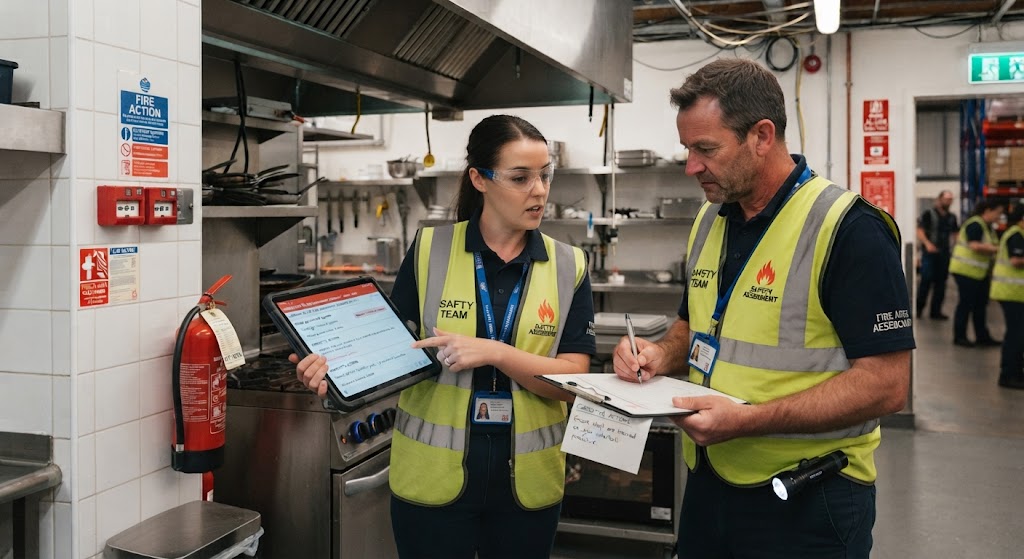
Organisations can use this simplified checklist as a starting point.
Ignition Sources
- Electrical equipment appears safe.
- Extension cables remain controlled.
- Hot surfaces remain separated from combustible materials.
- Hot-work activities follow an approved procedure.
- Smoking restrictions remain clear.
- Battery-charging areas remain suitable.
Combustible Materials
- Waste receives regular removal.
- Storage remains organised.
- Flammable materials remain controlled.
- Chemicals have suitable labels.
- Gas cylinders remain secured.
- Combustible stock remains away from ignition sources.
Escape Routes
- Routes remain clear.
- Exit doors operate correctly.
- Emergency signs remain visible.
- Emergency lighting receives maintenance.
- Staircases remain accessible.
- Alternative routes remain available.
People at Risk
- Visitors receive emergency information.
- Contractors understand the procedure.
- Employees requiring assistance have suitable arrangements.
- Night-shift employees have adequate coverage.
- Fire wardens cover every occupied area.
Emergency Arrangements
- Alarm procedures remain clear.
- Emergency contacts remain updated.
- Fire wardens understand their zones.
- Assembly points remain suitable.
- Employee headcount procedures work.
- Fire drills take place regularly.
- Corrective actions receive follow-up.
Common Fire Risk Assessment Mistakes
Organisations should avoid several common weaknesses.
Using a Generic Template Without Site Inspection
A template cannot identify hazards that the assessor has not observed.
The team should inspect the workplace and speak with relevant employees.
Focusing Only on Fire Extinguishers
Fire safety involves prevention, detection, evacuation, communication, training and emergency management.
The presence of extinguishers alone does not create a complete system.
Ignoring Temporary Activities
Maintenance, renovation, deliveries and contractor work may introduce new ignition sources and obstructions.
The assessment should consider these activities.
Failing to Identify Vulnerable Occupants
The organisation should prepare assistance arrangements before an emergency occurs.
Recording Problems Without Closing Them
A long list of findings provides little protection when management does not complete the actions.
Reviewing the Assessment Too Late
The organisation should update the assessment when workplace conditions change, not only after an incident.
Fire Risk Assessment for Different Industries
Every industry requires a different assessment approach.
Offices and Commercial Buildings
Assessors may focus on electrical equipment, pantry areas, high-rise evacuation, fire doors, visitors and shared escape routes.
Factories and Manufacturing Plants
The assessment may cover machinery, hot work, combustible production materials, shift arrangements, chemical storage and safe shutdown procedures.
Warehouses and Logistics Centres
Important risks may include packaging materials, stock arrangement, charging stations, vehicles, loading bays and long evacuation distances.
Hotels and Public Buildings
The organisation must consider guests, members of the public, night-time operations and people unfamiliar with the premises.
Healthcare and Educational Facilities
The assessment should address patients, students, large occupant numbers and people who may require assistance.
Chemical and High-Risk Facilities
These workplaces may require additional analysis involving hazardous substances, ignition control, chemical reactions, toxic releases, alternative assembly points and specialist emergency-response arrangements.
AFSA’s HAZMAT programme supports workplaces that need additional competency in hazard identification, Safety Data Sheets, storage, PPE and spill-response procedures.
Why Choose AFSA Academy?
AFSA Academy focuses on workplace fire safety, emergency response and hazardous-material preparedness.
Its services can support organisations through:
- Fire risk assessment preparation.
- Workplace fire safety inspections.
- Fire Safety Manager and Officer development.
- Emergency Response Team training.
- Fire drill preparation.
- Firefighting exercises.
- HAZMAT training.
- Emergency planning.
- Practical scenario-based training.
AFSA’s current FSM and FSO programme information also highlights hazard inspection, fire protection checks, escape-route monitoring and evacuation coordination as key workplace responsibilities.
A combined approach helps the organisation connect assessment findings with employee competency and emergency procedures.
Conclusion
A fire risk assessment helps an organisation understand how a fire could start, who may face danger and whether existing controls remain effective.
The process should begin with a workplace inspection and a review of actual operations.
Next, the assessment team should identify ignition sources, combustible materials, exposed people and evacuation weaknesses.
Management should then prioritise practical control measures, assign responsible personnel and monitor every corrective action.
Finally, the organisation should train employees, test its arrangements and review the assessment whenever workplace conditions change.
A fire risk assessment Malaysia workplaces can depend on must remain practical, current and connected to the Emergency Response Plan.
Organisations that need professional support can contact AFSA Academy to discuss workplace inspections, fire risk assessment, emergency training and corrective action planning.
Frequently Asked Questions
What is a fire risk assessment Malaysia workplaces should conduct?
It is a systematic review that identifies fire hazards, evaluates the people and operations at risk and recommends suitable prevention and protection measures.
Is a fire risk assessment the same as a fire safety inspection?
A fire safety inspection forms part of the assessment. The full assessment also evaluates risk levels, people at risk, existing controls and corrective actions.
Who can conduct a workplace fire risk assessment?
The organisation may involve competent safety personnel, facility managers, Fire Safety Managers, Fire Safety Officers and suitable external professionals.
What fire hazards should the assessment cover?
It should review ignition sources, combustible materials, electrical risks, chemical storage, housekeeping, hot work, emergency exits and fire protection arrangements.
How often should an organisation review its fire risk assessment?
The organisation should review it regularly and whenever the layout, occupancy, equipment, materials, processes or emergency arrangements change.
Does the assessment need to cover visitors and contractors?
Yes. The assessment should consider everyone who may be present, including visitors, contractors, temporary workers and delivery personnel.
What is the difference between fire risk assessment and HIRARC?
HIRARC provides a broader workplace hazard identification, risk assessment and risk control framework. A fire risk assessment focuses specifically on fire-related hazards and consequences.
Should the assessment include emergency exits?
Yes. The assessor should review escape routes, exit doors, signage, lighting, staircases, obstructions and alternative routes.
What happens after identifying a high-risk fire hazard?
The organisation should introduce immediate controls, assign corrective action and verify that the risk has been reduced before relying on normal operations.
Does a fire risk assessment replace an Emergency Response Plan?
No. The assessment identifies risks and required controls. The Emergency Response Plan explains how the organisation will respond during an incident.
Can AFSA assist with fire risk assessment and training?
AFSA provides fire safety consultancy, inspection support and practical training for FSM, FSO, ERT, firefighting and HAZMAT responsibilities.
How can an organisation arrange a fire risk assessment?
The organisation can contact AFSA Academy with details about its premises, industry, workforce, hazards and required assessment scope.